
With millions of YouTube channels available, it can be challenging to discover content creators from a specific location. So, if you’re interested in supporting local YouTube creators, or you’re curious about content produced in a certain region, or need help with competitor research (yes! it’s doable) -YouTube offers tools to help you narrow your search by location. In this guide, we’ll break down 4 ways to search YouTube channels by location in 2026, the limitations of each, and some insider tips no one usually talks about.
|
Method |
How It Works |
Pros |
Cons |
Best For |
|---|---|---|---|---|
|
YouTube Filters |
Search + filter by Channel |
Free, simple, fast |
No exact location, manual check needed |
Quick local search, casual users |
|
Third-Party Tools |
Tools like GeoFind, Channel Crawler |
Maps creators, filter by niche & size |
Only geotagged videos, may cost, not 100% accurate |
Marketers, influencer discovery |
|
Google Operators |
site:youtube.com + keywords + location |
Finds hidden channels, sees metadata YouTube ignores |
Personalized results, outdated info, manual verification |
Micro-influencers, competitor research |
|
YouTube API |
Code queries for channels/videos, filter by geo |
Scalable, precise, real-time |
Needs coding, rate limits, not all channels geotagged |
Developers, brands, large-scale research |
Method 1: YouTube Search Filters
Very few people actually know or use most (or any of the) YouTube filters. And while they (the filters) are far from perfect, they can be surprisingly useful if you know how to hack them.
-
Go to YouTube and type a location-related keyword. This could be the city, neighborhood, or a slang term locals use. For example: “LA vlogs” or if you’re looking for travel YouTube channels in Canada, you can search “travel YouTube channel Canada.”
-
Hit Search.
-
Click Filters at the top right of the results.

-
Under Type, choose Channel. This removes videos and shows only channels.
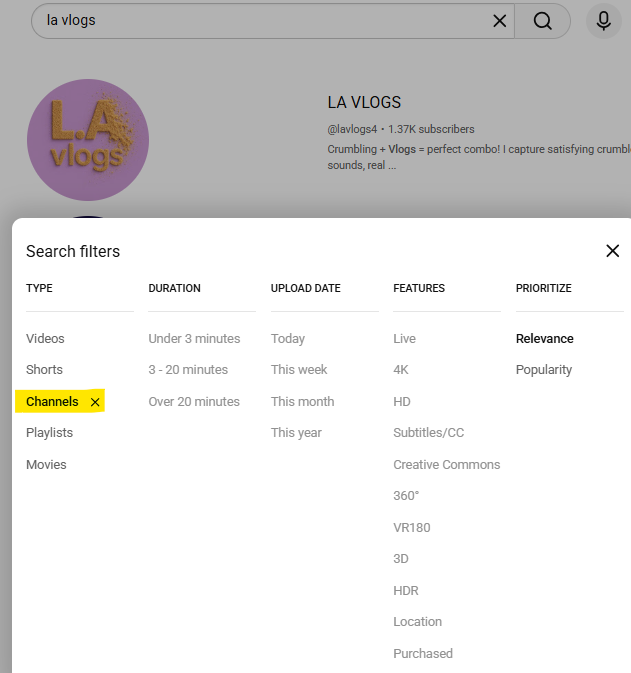
This will help you easily find YouTube channels, but it’s far from perfect. Many creators don’t even mention their location in their channel name or description. You might see “Los Angeles” in the results, but some could be filming in New Jersey. This is common since creators rarely geotag profiles.
Important to note: YouTube hides state or local information to make videos more likely to go viral,
So, when YouTube shows a creator’s “Location,” it usually looks at where the video was made. It IGNORES the channel’s “About” page, where creators might write something like “Based in Los Angeles”.
Location filter on the Channel Page
YouTube allows you to filter videos by location on a specific channel page. Here’s how you can do this:
-
Open the channel page of a YouTube channel.
-
Scroll through the channel’s videos, and under each video title, you may notice location tags. These tags indicate the location where the video was uploaded from, which helps you understand where the content is being created.
-
This feature is useful if you are trying to explore videos or content from only videos created in a specific location.
Tips if you use this method
Once you have a list of channels, visit their “About” page. As we already stated, many creators mention their city, even if it’s just a vague hint like “NYC-based foodie.” You can also look at recent uploads: local landmarks, street signs, or regional dialects are giveaways.
Also for better results, combine city names + niche topics.
“Los Angeles food vlogs”, “Miami tech review” etc.
Mixing niche with the location increases the chance (even if only a tiny bit) that you find real local channels, not someone mentioning the city once in a video.
Limitations of YouTube location filters
-
No true geolocation search. YouTube doesn’t let you filter strictly by creator location.
-
False positives. Some channels might include city names in a clickbait way
-
Manual work. You have to scroll and check descriptions yourself.
Method 2: Third‑Party Tools
Another well-known method on how to search YouTube channels by location is using tools. These tools are designed for people who want real results and less manual work. With some of these tools you can find local channels, niches, influencers, and even contact info, without endless scrolling.
One tool we want to mention here is the “Matt W’s YouTube Geofind tool”.
MW GeoFind is a free online tool that helps you find YouTube videos that have geographic location tags (geotags). It does NOT guess where videos were made automatically. It only finds videos where the creator has explicitly added a location.
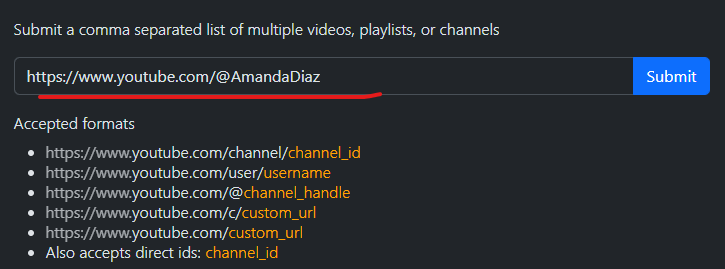
The tool works in several search modes:
-
You can search by channel ID or handle
-
You can search by username
-
You can check by URL
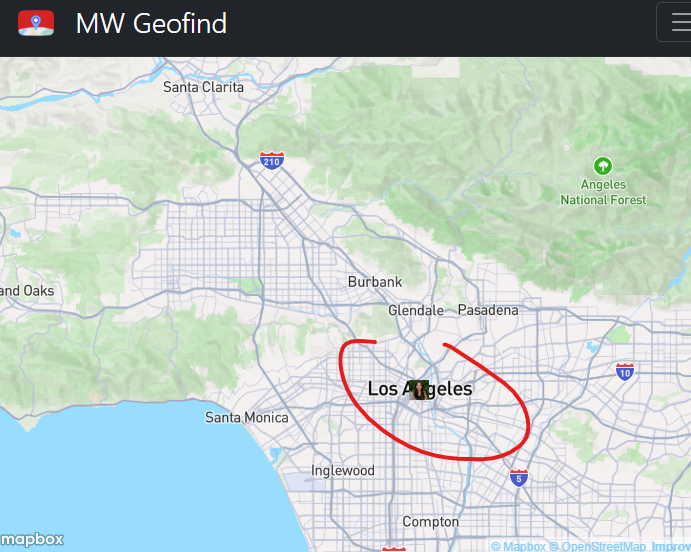
Results are shown on a map with pins for each video that has geolocation metadata. You can click these pins to see video details, including title, channel, and upload date.
Limitations of THIS tool when you search YouTube channels by location
• YouTube geotags are optional. Most videos don’t have them, so this tool only finds a subset of location‑tagged content.
• The location data comes from what the creator entered in YouTube’s settings, not from hidden GPS in the video file.
Paid tools
There are also many paid tools. One of them is Channel Crawler for example. These and similar services let you:
-
search millions of channels
-
filter by country
-
filter by subscriber range
-
filter by niche
On Reddit, one user shared their experience using Channel Crawler for YouTube creator discovery. They said the tool was “pretty useful” for finding creators by size and category, as long as you don’t burn through search credits too quickly. However, they did not mention location, which is a key limitation if you’re trying to find creators based on where they actually are.
Things to keep in mind about this location filter method
No tool will ever give you 100% accurate “location” unless the creator explicitly states it. Location inferred by country filters or geotags can be wrong, outdated, or based on where the audience mostly watches, not where the creator lives.
YouTube’s own algorithm biases search results based on your own location, history, and device settings. And unfortunately, many tools that use YouTube data don’t always get around that entirely.
Some tools sell email lists or contact info. But those lists can be stale or against GDPR/CCPA rules if not properly sourced. Always ensure you’re compliant when reaching out to creators.
Method 3: Google Search Operators
Google search results can also help narrow down the results when you search YouTube channels by location. After all, YouTube is owned by Google. That means every public YouTube channel and video is indexed by Google. And, if you know how to talk to Google properly, you can find almost anything… including creators in a specific city, niche YouTube channels, or even content style.
To do that:
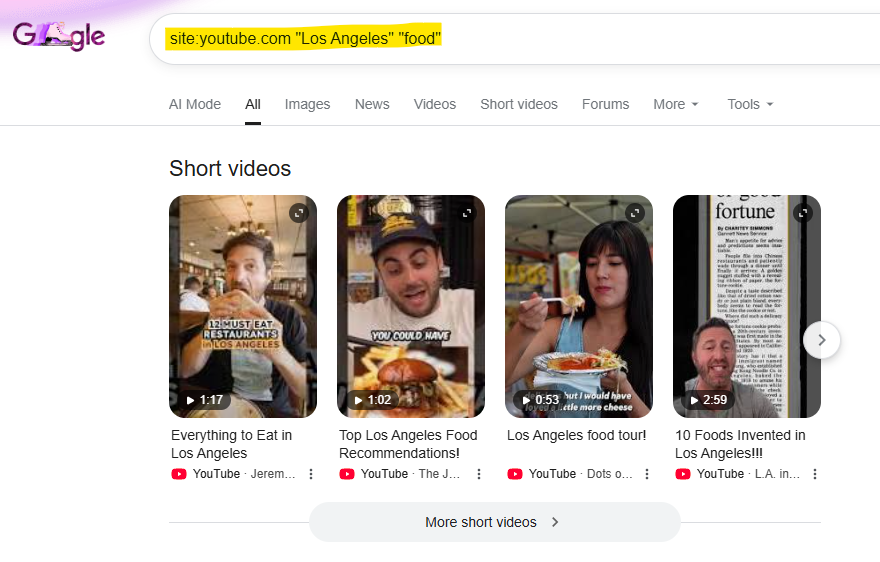
Open Google search and type site:youtube.com “Los Angeles” “food”
This tells Google:
-
Only show me results from YouTube
-
Look for pages that mention Los Angeles AND food
Why this method works better than YouTube’s own search
Google indexes text outside the YouTube search scope, meaning it can “see” more. More About pages, captions, and video metadata, things that YouTube’s internal search mostly ignores. Google’s engine beats YouTube’s, surfacing hidden channels with 2-3x better relevance for niches.
Some users even say that over 40% of their channel’s traffic comes from Google Search.
YouTube focuses on content discovery (what keeps you watching), while Google focuses on information retrieval (what matches your keywords).
You can ALSO search things like:
-
site:youtube.com/channel “based in” “Melbourne” “photography” (creators based in that city/state/country)
-
site:youtube.com “vlog” “Boston” “neighborhood” (find vlogs)
-
site:youtube.com “sponsored” “Los Angeles” “restaurant” (sponsored content)
Limitations of this method
-
Google personalizes everything. The results you see in New York won’t match someone searching the same phrase in Toronto (presuming you’re doing the exact same search). Because your IP address affects what Google thinks is “relevant” to you and your search result biases future results.
-
Plus, creators lie and this one’s not Google’s fault. Some creators never update their bios. Others keep old city names because they think it boosts discoverability. So there’s also that to keep in mind.
-
Google indexes pages for years. A channel that hasn’t posted since 2021 can still appear high in results because its About page still lives somewhere in the index.
Method 4: YouTube API (for developers)
YouTube’s API lets you programmatically query YouTube’s database if you’re a little technical.
Here’s a step-by-step to get US-focused channels, say… fitness creators in Texas:
-
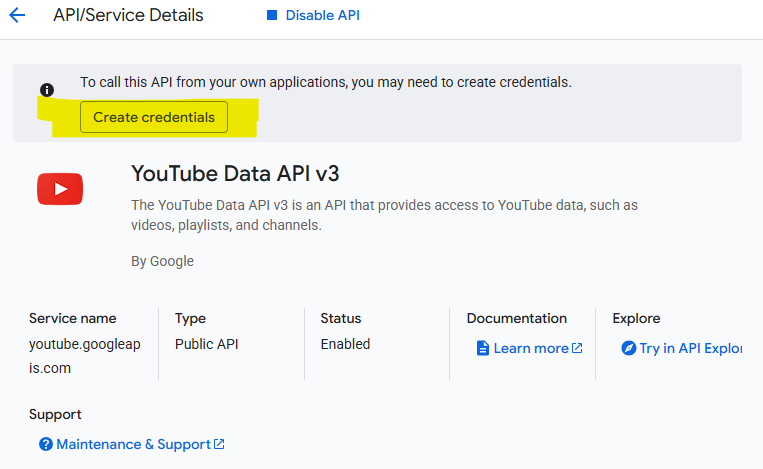
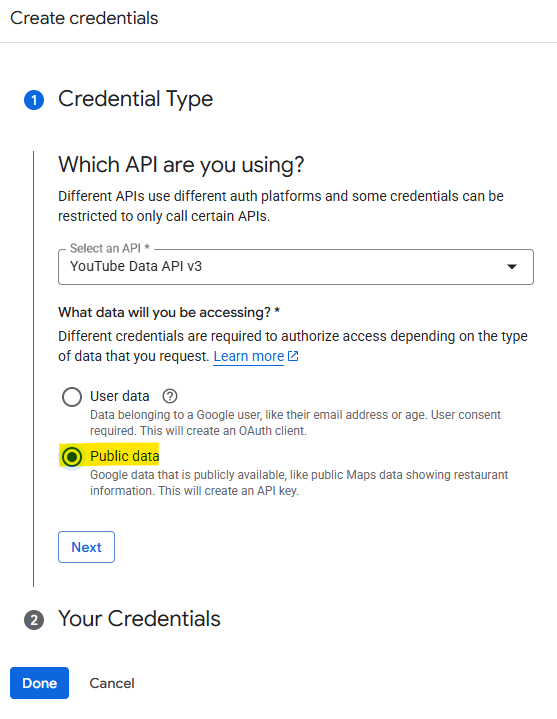
Step 1. Get your API key: Head to console.cloud.google.com/apis/library/youtube.googleapis.com
→enable YouTube Data API v3 (In this case, it was already enabled)
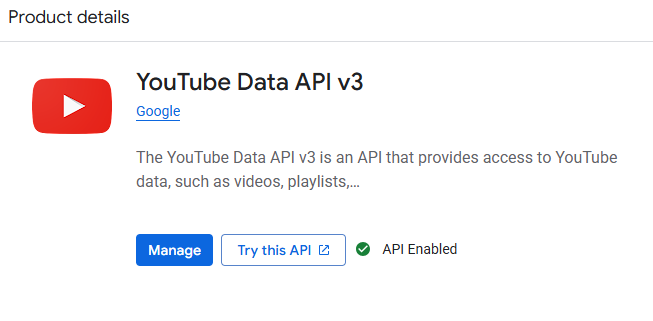
→ create credentials (API key tab).
NOTE: at the end of the link, you should add your API key, where it says [YOUR_API_KEY]
-
Step 3. Extract channel IDs from results.
-
Step 4. Then query https://www.googleapis.com/youtube/v3/channels?part=snippet,statistics&id=CHANNEL_ID1,CHANNEL_ID2&key=KEY
CHANNEL_ID1 and CHANNEL_ID2 should be where you add the IDs you extracted.
-
Step 5. Check descriptions for “based in Texas/TX”
Benefits of this method
-
Unlike Google search or third-party tools, you can use actual geolocation coordinates, not just keywords.
-
You can query hundreds or thousands of channels and automatically pull stats like views, uploads, and engagement metrics.
-
Once set up, it can update daily, giving you real-time info about influencer/market research.
Limitations of this method
-
Not every channel has geotagged videos. Many creators leave it off, so you’ll still miss a lot.
-
Rate limits. YouTube API has strict daily quotas and each search or channel request consumes units. Run too many queries too quickly, and you’ll hit the limit.
-
Requires coding skills. Python, JavaScript, or another language is needed. You also need to understand API authentication, request formatting, and JSON parsing.
-
Potential outdated info. API data depends on YouTube’s backend updates. And once again, if a creator moves cities, geotagged videos remain historical unless they manually update them (the videos).
Why would anyone want to search YouTube channels by location?
So you’ve learned 4 different ways to find YouTube channels by location:
-
YouTube search filters
-
Third-party tools
-
Google search operators
-
YouTube API
All solid methods, each with strengths, weaknesses, and quirks. But the question is: why bother?
1. Search YouTube influencers locally
Everyone obsesses over mega YouTubers (the 10M+ subscriber channels), but not every brand can hire them. Some just want to find micro influencers or even nano influencers.
For several reasons really:
-
Their audience is hyper-engaged
-
They respond faster to messages and collaboration requests
-
Their content feels authentic and local, which builds trust
-
They’re cheaper
But search is dominated by the larger creators, which makes it necessary to narrow down the search.
2. Competitor research
YouTube channels often reveal hidden strategies of competitors:
-
Which neighborhoods or cities competitors are targeting?
-
What type of content (their content) is doing particularly well locally?
-
What seasonal trends and/or promotions are they doing?
You can even track geo-specific performance over time with the YouTube API. For example, you want to know if your competitor’s new video is gaining traction in a specific zip code? The API + geotagged data makes it possible. Most agencies charge thousands for this insight, but it’s accessible to anyone willing to dig.
See also: How to Block a Channel on YouTube: 4 Options That Work
3. Brand partnerships
If your goal is to collaborate with YouTube channels/creators, location-based searches are a goldmine. Why? Because most brands target influencers globally, ignoring local creators who can create authentic, context-rich campaigns.
BONUS: Using the API, you can find who has previously worked with similar local businesses, giving you pre-vetted partners. Many marketers never go this deep. Which means less competition and higher ROI for you.
4. You can discover untapped niches
The best use case? Finding creators in niches that are totally ignored locally, because, honestly, most brands and marketers only look at obvious niches like food, fashion or tech. Using the 4 methods together, you might discover:
-
A tiny eco-friendly lifestyle channel in… say..Portland with 3k subs but huge engagement
Similar creators often outperform big channels in local campaigns, but not everyone knows to contact them.
Final Thoughts: How Location Can Enhance Your YouTube Experience
Searching for YouTube channels by location may not be as simple or easy as some other features, but by using these 4 methods we’ve shared here, you can easily find YouTube channels from specific regions.
Whether you’re exploring local content or seeking collaboration opportunities with creators, YouTube offers several ways to access location-relevant content.
If you’re looking to grow your own YouTube channel or need professional help editing your videos, consider partnering with Vidpros.
Vidpros offers top-notch video editing services to help your content reach new audiences, no matter the location. Reach out to Vidpros today to take your YouTube content to the next level!