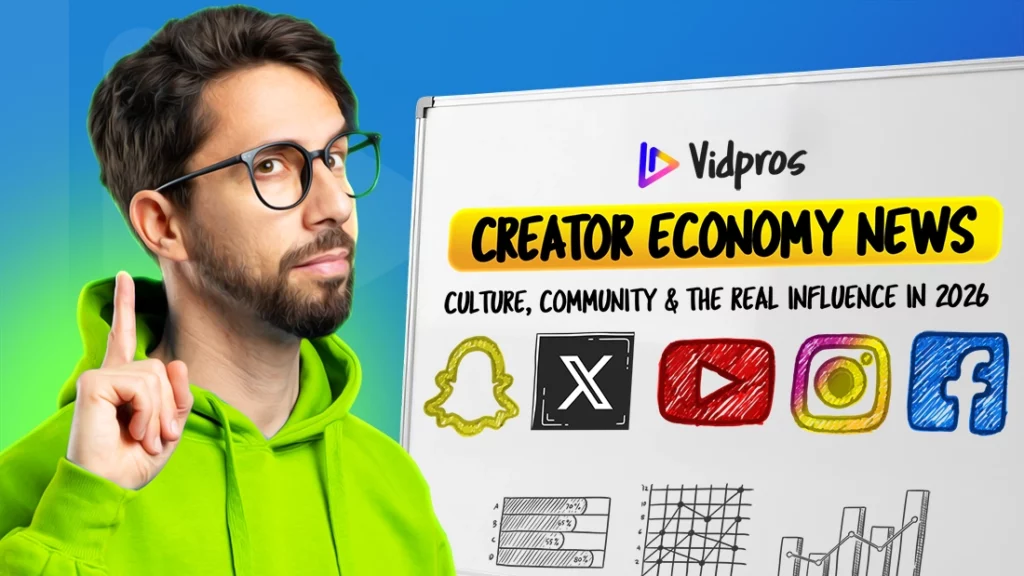
The creator economy news cycle is quick. One week, somebody is being canceled. The next week, they’re launching a new brand like nothing ever happened. It’s chaotic. And yet… it’s also kind of revealing.
Because if you look at it from a different perspective, this space isn’t really about followers anymore. It’s about influence (the real kind of influence, to be honest.)
The kind of influence that determines what people buy, read, believe in, and even how they view themselves.
From content that performs to content that connects. From polished personas to people who feel real.
And you see this everywhere: in canceled creators, in brand deals gone completely wrong, in communities operating in the shadows and influencing trends, and in movements like BookTok, where regular people can make unknown books worldwide hits.
In this article, we’re digging into all of this with recent creator economy news from 2026.
When influencers fall
Every few months, creator economy news highlights another fall from grace. Canceled creators. Deleted channels. Broken reputations.
And most of the time, it is a series of small actions that gradually lead to an influencer being canceled due to things such as them not being very good at saying things that don’t sit right with the public, not being very good at being transparent about things, and not being very good at being who they are online.
(A lot of content creators focus on top of funnel growth, that’s why they get canceled eventually.)
However, what makes this topic more complex is that being “canceled” does not always mean the end of a career.
Some canceled influencers and YouTubers in 2026 (20+ cases) have managed to rebuild their image, others have completely rebranded themselves, and some have even grown by leaning into the controversy (not avoiding it.)
Simply said, the outcome is not just about the situation itself, but (also) about how the audience feels about the creator before anything goes wrong.
Content creator vs influencer. Aren’t they one and the same?

Not really.
If you’ve ever felt like something was “off” about those labels, you’re not wrong. Because when you actually break it down, the difference isn’t just what they do… it’s why they do it.
A content creator is focused on the content (the product) because they’re making something. The content is the main character, and they act more like media companies.
BUT, an influencer IS the product. Their personality, lifestyle, and opinions are what people want to engage with. The content is more personal, more raw, and even more related to brand collaborations/advertisers and opinions that dictate what people consume.
All influencers are content creators. But not all content creators are influencers and treat it as jobs.
(Even though they both work and they both earn money.)
But they attract different people… and different expectations.
So, how to become a content creator by mistake, like Alex From Target or Lyn Slater? It is not easy to reproduce mistakes… because, well, they’re mistakes. But you can also try the work, start finding the type of content you enjoy and start making it.
Brand-influencer partnerships gone wrong
With a growth in influencer marketing from $2 billion in 2016 to over $30 billion by 2025, influencer-brand partnerships don’t fail because of bad content; they fail because of bad decisions.
Unfortunately, on paper, most collaborations look solid with big audiences, strong engagement, good numbers, etc. But that doesn’t mean they can’t fail, especially when what people expect from that influencer and what the brand expects are different.
The influencer economy runs on trust. And the second that trust feels off, the whole partnership will feel off and fail.
Some of the most major brand-influencer partnerships gone wrong (and their lessons) are the Mr. Beast Burger, FTX, and the Fyre Festival.
- Lack of vetting.
- Too much speed.
- Not enough transparency.
- Selling before understanding
- Promoting before questioning
- Trusting the deal more than the product
-All the main reasons why these partnerships failed hard (business failures disguised as content problems.)
(If you’re thinking “that would never happen to me”… that’s exactly where it starts, so always do your due diligence.)
The rise of BookTok (Influencers shaping what we read?)
People love to say “don’t judge a book by its cover”, but BookTok made people judge books by a 15-second emotional breakdown.
This niche of TikTok has grown to become a huge community of readers with billions of views, ranging from chaotic book rants to silent book reviews, and has become what many consider the most powerful word-of-mouth engine publishing has ever seen.
And honestly, that’s not an exaggerated statement.

Books which previously went unseen for years are suddenly rising up the bestseller lists, entire genres such as romantasy and young adult fiction are seeing huge resurgences.
And even writers can achieve success in a few months or years, all thanks to a few viral videos from top BookTok influencers that have captured the imagination of the right demographic.
What makes BookTok especially powerful is that it doesn’t feel like marketing at all… it feels like obsession, and people trust obsession far more than they trust ads.
Best communities (for creators to connect & grow)
No matter how good your content is…If you’re building in isolation, growth will always feel slower.
That’s why online communities for content creators have become such a big deal recently. And there are some communities you can find on different platforms.
Of course, not all of them are good (some are just noisy for the sake of noise), but there are some good ones out there.
Take a few examples:
- Facebook Groups are everywhere, but quality varies a lot.
- Discord communities can feel overwhelming, but they’re insanely valuable once you find the right one.
- Reddit communities have the best ideas… and the harshest feedback.
- LinkedIn communities connect you with people who are making money in the space while also creating.
- Patreon turns followers into a paying community.
- Mighty Networks gives you full control if you want your own space.
Each one works in a different way. But that’s the beauty of it.
Some are good for newbies, some are not. Some are good when you already have some momentum.
In fact, many of these platforms provide things that most creators never think about (learning, live events, or connecting with other creators).
The vitality of YouTube Talent Managers
If you follow creator economy news, you might have noticed two creators with the same talent, in the same niche with the same consistency.
So, why does one blow up… and the other stays stuck?
A big part of it comes down to something some (smaller) creators ignore: who’s managing the business side.
Because once you reach a certain level, content alone isn’t enough, and you need brand deals, collaborations, and many revenue streams.
Some of these top 20 YouTube Talent managers in 2026 are known for working closely with creators and for building brand value, and some are known for working on expanding creators beyond YouTube and into other forms of media or even transitioning into broader entertainment spaces like TV and film.

Which means that the influence of a manager could have a significant impact on not only the income of the creator but also on the overall course of a creator’s career.
And that’s exactly why looking into who these managers are is important, because as you start to connect the dots, you start to see the patterns with the top creators and who is really helping them make these moves behind the scenes.
Femvertising (what’s that?)
Femvertising is one of those concepts that sounds simple… until you actually try to define it.
But, you’ve probably seen it in action… ads that celebrate women, challenge stereotypes, or advocate for equality. At its core, femvertising is more than just promoting a product. It’s about creating stories that celebrate women, challenge stereotypes, and make something that people care about.
Is it real?
Is it just marketing dressed up as activism?
This is the tension that brands currently operate within.
While some campaigns manage to get the balance just right (like these femvertising video ads examples), feeling intentional and connected to a message that actually matters, others completely fail to deliver and feel forced.
That’s why femvertising is such an interesting space to watch. Because it’s what makes it tricky to pull off in the first place as it’s not enough to just “include” women in an ad. The message, tone, and intention ALL need to line up.
It is visual, emotional, and often (you didn’t guess it) subtle. You only fully understand it when you watch it.
FAQ
1. What is the creator economy?
So, the creator economy is basically the economy where people earn money through the creation of content, building their own audience, and making money off them. It is not about working your way up the corporate ladder or working for the media to earn a living.
It is about using your own content to earn your living.
The main idea behind this is the idea that attention is the new currency. So, if you can attract people’s attention, you can actually earn money off it. But it is not surefire.
2. How do influencers make money beyond sponsorships?
Money in the creator economy works best when it’s diversified because relying only on sponsorships can be risky. That’s why many creators focus on building more control over their income.
They create ways to earn directly from their audience instead of depending on brands. This can include digital products, services, or even community-based income models.
The smartest creators treat sponsorships as a bonus, not the foundation, because the real goal (ultimately) is to build something they fully own.
3. What’s the difference between a content creator and an influencer?
The content creator focuses on what he or she creates.
The influencer focuses on what he or she influences.
The content creator can be successful even with low numbers. The influencer relies on trust and… influence.
The truth, however, is that these two roles overlap. The most successful individuals today have both qualities.
In the creator economy, both matter. Content gets attention. Influence turns that attention into action.
4. How do you find the right community as a new creator?
We don’t think creators really find their community to begin with. We think they build it.
You start by creating content, even if it’s not perfect. And then over time, the people who vibe with your voice start to appear. Some will stay, and some won’t. And that’s okay.
The thing to note, though, is that your message can’t be changing all the time. If your message is changing all the time, then your community won’t know what to make of you.
Your community, essentially, is the people who stick around after a few interactions. That’s what you should really be paying attention to.
Capping off
The point of staying current on creator economy news isn’t just to stay current.
It’s to know where the creator economy is really going. It provides context. It helps you make decisions. And it prevents you from falling behind in a world where things move quickly.
And, it isn’t enough to know what’s going on. You have to act on it.
Adjust your content. Polish your message. Make better videos, faster…
And if you think you can’t handle all that, maybe it’s time to consider a fractional video editor. Check out Vidpros pricing, and if you’re not sure, then watch the demo to get started and win that $100 trial (10 hours of professional editing).

People who act on what they learn are the ones who actually move