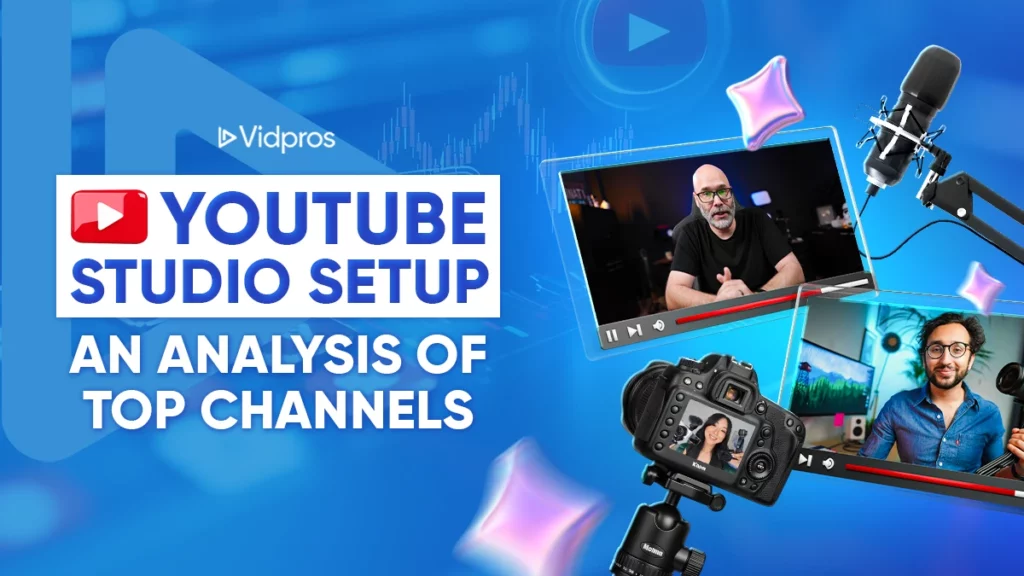
YouTube’s own data shows that retention (meaning how long someone stays watching) is one of the biggest signals the algorithm uses to decide whether to promote videos to more people. High audience retention doesn’t just help this video perform; it helps YouTube recommend your next videos to new sets of viewers. That’s why, your YouTube studio setup affects how long people watch more. And minor (or major) changes in lighting, background, and composition can boost said watch time, which is the lifeblood of growth on a YouTube channel.
Here’s a quick list of what you need to worry about before anything else in your YouTube studio setup:
- Lighting = natural + dedicated lights to eliminate harsh shadows
- Background depth = not just plain walls
- Color = intentional contrast between subject and background
- Camera, lighting and sound = subtle but powerful
- Framing= consistent headroom and desk layout
- Teleprompter= so you keep looking at the camera
We’ve also included non-affiliate Amazon links so you can easily find the exact models mentioned.
Inside top creators’ studios: YouTube studio setup breakdown
When it comes to building a YouTube studio setup that actually looks professional and keeps viewers watching, there’s a big gap between what most beginners do and what top creators actually do. Instead of just showing gear lists, we’re breaking down real studios, what’s in the room, why it works, and how you can DIY it.
Nick Nimmin’s studio

Nick Nimmin for his YouTube channel normally relies on budget-friendly, accessible equipment for high-quality results, as detailed in his gear tours.
He’s shared his setup in older tours, and it hasn’t changed much.
Camera gear
His YouTube studio setup includes high-quality cameras paired with prime lenses to get sharp, cinematic footage. One of his key lenses is the Sony SEL35F18F FE 35mm F1.8, a wide-angle prime with a large aperture that creates a smooth, shallow depth-of-field effect. The wide aperture helps in low-light conditions, ensuring his videos stay crisp even in dimmer home studio lighting.
Lighting
He uses a combination of Godox lights and Philips Hue smart bulbs to create a visually appealing studio environment. The Godox SL-60 LED Video Light provides soft, even illumination for his face, while while the Kamerar Dfuse softbox smooths it out to avoid harsh shadows.

For more creative and color-adjustable effects, he adds the Godox TL60 Full-Color RGB Tube Light, which can be controlled via an app, remote, or DMX system. To complete his setup, Nick integrates Philips Hue White & Color Ambiance bulbs along with a motion sensor, allowing him to adjust moods and automate lighting changes easily.
Sound
Nick uses the Shure SM7B Vocal Dynamic Microphone, a studio-standard mic known for its warm, smooth sound and wide frequency range. It comes with a detachable windscreen, making it ideal for recording voiceovers, streaming, and podcasts.
Charlie Chang’s studio setup

Photo source: https://www.youtube.com/shorts/VXncYI-KKOE
Camera Choices
Charlie Chang uses the Sony a7 III, a full-frame mirrorless camera (unlike Nick Nimmin, who leans more on lenses like the Sony 35mm on smaller sensors or GH-series cameras.) The a7 III gives Charlie more dynamic range and better low-light performance straight out of the camera, which is useful for more cinematic shots without needing tons of extra lighting. It also allows for interchangeable lenses, giving him flexibility to switch between wide, tight, or creative focal lengths depending on the content.
Lighting
This is where the setups diverge quite a bit. Charlie relies heavily on Neewer gear, including an 18-inch LED ring light and a 700W equivalent softbox kit. Ring lights give a very uniform, face-forward glow that’s popular for beauty, tutorial, or vlogging content, whereas Nick’s Godox + Hue approach is more cinematic.

Neewer softboxes give soft, and continuous lighting, which is easy to place and replicate, though they may not be as flexible in terms of changing the mood or color, unlike Nick’s RGB tubes and bulbs.
Audio and mounting
Charlie keeps things simple on audio with the RØDE VideoMic GO, a lightweight on-camera shotgun mic. It’s easy to use and effective, but it won’t give the studio-level warmth and depth of Nick’s Shure SM7B.

Tripod-wise, Charlie uses the Vanguard VEO 235AB, a travel-friendly aluminum tripod with ball head…which is practical for portability and quick setup.
Ali Abdaal’s studio setup

Photo source: https://www.youtube.com/watch?v=MBPHU7aaklM
Ali’s backdrop feels calm, smart, and intentional. The bookcase behind him (including his own titles) creates a sense of depth and focus without being busy, while touches of greenery bring life and energy to the space.
Ali Abdaal’s setup immediately shows a focus on comfort and long-term workflow. For one, he uses the Oakywood Solid Oak Standing Desk paired with an Anthros Ergonomic Chair. Unlike Nick or Charlie, Ali invests heavily in ergonomics, suggesting he values long hours at the desk as much as on-camera production.

Photo source: https://www.youtube.com/watch?v=4eq7ienNumY
Camera & lighting
He uses the Sony A7S III, A7C, FX3, and even a Fujifilm X100VI. He is able to get a wide range of shots with this equipment, including talk-to-camera shots, b-roll shots, and even mobile shots.
For lighting, he relies on Amaran F22x key lights and Tube PT4C lights, giving him soft, adjustable illumination which as he likes to say “it’s foldable when I have to move…It makes such a difference having a key light”.

Audio
Ali uses both Elgato Wave Neo for desk audio and the Sennheiser MKH 416 for cinematic-quality recording. Paired with the Rode PSA boom arm, his audio is clear, flexible, and easy to manage.

This is a step up from Charlie’s simple on-camera shotgun and even Nick’s Shure SM7B for solo setups. Ali seems to be more focused on versatility for live recording, editing, AND streaming.
He uses this Elgato teleprompter as well.

Think Media’s studio setup
Photo source: https://www.youtube.com/watch?v=cCISdKD3ikI
Audio
A shotgun microphone such as the Deity D4 Mini or the Rode VideoMic Go II is used for clear and directional audio. Unlike the Ali or Charlie setup, where they tend to use static podcasting microphones, the choice is for clear audio even while in motion.
A podcast microphone like the Shure SM7B/SM7DB adds depth and warmth to talking head videos, helping to create that intimate, immersive audio that Ali’s set achieves so well. Audio interfaces like the RodeCaster Pro II or Vocaster Two bring everything together in one unit with balanced levels and a polished finish that not all creators focus on with multiple-piece equipment.
Cameras
For in-studio recording, Think Media recommends Canon R50V, which bridges casual and semi-pro content and is perfect for beginners, it has to be said.
When it comes to lenses, there are several options Think Media mentions. For example, budget primes like Viltrox 20mm or Sigma 16mm used for wide(r), more intimate shots. And then, he mentions the pro primes (Sony 20mm f/1.8) and zooms (Sony 24-105mm), which are great for cinematic isolation.
Lighting
LED panels, Amaran Verge, and accent lights (Ace 25C) create depth, warmth, and contrast without looking staged. While other creators stick to desk lamps or softboxes, this approach uses layered lighting to define mood, shape, and movement, making small spaces feel expansive and professional.
Vanessa Lau’s studio setup
Camera
Vanessa Liu’s setup revolves around a Sony camera with an ultra-wide lens, a choice that instantly changes the mood of her videos. The wide framing allows her to include more of her environment and gives her content a sense of space and movement (which is why many creators use them).
Lighting setup
Her lighting choices are simple but smart. The main light is an Amaran 100x bi color, which is a good choice in this case if you want soft AND even illumination, wrapping around your face.
The lighting stand (in her case it’s a NEEWER Pro 9ft) makes everything flexible, which is great for small apartments or for scenarios where you want to alternate between work, filming, etc.
Audio
Her microphone setup is straightforward, clean, plug-and-play audio that works right out of the box, reinforcing her no-fuss, efficient workflow. The tripod, dummy battery, and Bluetooth remote show her focus on independence: she’s filming solo, likely in compact spaces, so she prioritizes reliability and ease of setup over high-end complexity.
Building your own studio for your YouTube channel, even on a tight budget
You can make a YouTube Studio setup work in your living room, closet, or even a corner of your house, as long as you think in terms of layers, depth, and vibe.
Step 1- Choose a room or corner that helps you have some level of control over the light and sound dampening. You need to ensure that the area is not too echoey or too noisy, especially if it’s near the window or the AC unit. You must also consider the background’s aesthetic quality once it’s in the frame.
Step 2- If you have the space for it, place your desk at least 3-4 feet away from the wall. This will ensure that your camera lens is able to slightly blur the background, giving your video that “cinematic” effect that you see in most professional videos.
Step 3- Build a backdrop
The following are some simple backdrop ideas:
- Bookshelf setup: IKEA KALLAX (from $29) + warm light strip + personal items
- Plain wall + RGB: Use an Elgato LED strip behind your desk for a glow
- Cinema lightbox sign: Add a short phrase or your name for example
- Plant + art combo: A fake plant and framed print instantly add dimension
- A fake YouTube plaque: It’s fun, so why not?
Step 5– If your room is echoey, throw down a rug or hang a thick blanket just off-camera. Even budget sound-dampening foam (like 12 panels for $30 on Amazon) makes a big difference.
Capping off
A solid YouTube studio setup isn’t about how much you spend: it’s about how much intention you put into it.
Every creator you admire started with awkward lighting, bad angles, and echoes bouncing off their walls.
You don’t need a fancy office or ten lights to look professional. You just need to design your space to support your story.
Because at the end of the day, people don’t subscribe for your camera.
They subscribe because of you.
So build your setup, tweak your light, move that chair, hang that backdrop, and hit record. EVEN if it’s not perfect yet.
And when you’re finally ready to turn your videos into something clean and polished, get a pro editor to do it for you.
Vidpros is now offering a $100 trial where you can hand off 10 short-form videos (or 1 long-form) and see your content cut, color-balanced, and ready to post.

Because a good studio helps you record.
But good editing? That’s what makes people remember you.