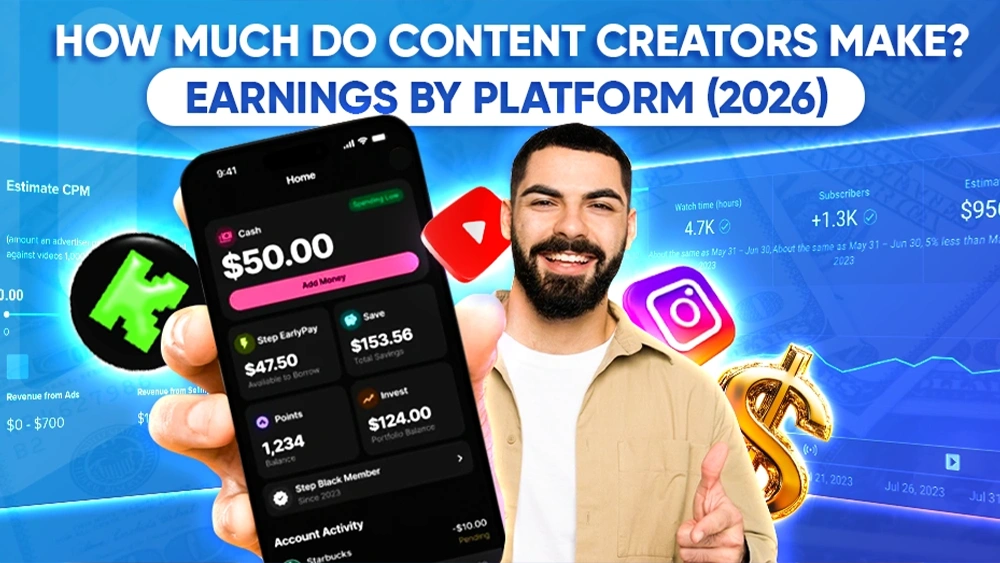
“How much do content creators make?” – It’s probably the first question people ask before hitting “post” for the first time.
And honestly, we get it. Social media makes it look easy. One viral video, a few brand deals, and suddenly you’re making thousands, just after you click that first “post”.
And for some is easier than for others. Some creators earn a few extra dollars a month. Others turn content into a full-time income. A small percentage build multi-million-dollar businesses.
Same platforms. Same tools. Very different outcomes.
So what actually drives those numbers?
- Platform choice (and the type of content creation.)
- Audience size
- Engagement (not just followers)
- Monetization strategy for each platform, etc., etc.
That’s what makes the creator economy confusing. It’s one of the few industries where two people doing the “same job” can earn completely different incomes. One posts casually and makes coffee money. The other turns it into a full-time business.
In this article, we’re breaking it all down. Real earnings range, platform by platform.
For example:
- YouTube pays for views through ads.
- TikTok pays less directly, but brands pay more.
- Instagram rewards influence more than reach.
- Twitch depends heavily on loyal communities.
You’ll see realistic earning ranges, what impacts income the most, and where the biggest opportunities are right now.
How much does Instagram pay per million views?
Also, unlike other platforms, there is no clean “pay-per-view” model on Instagram. You don’t simply hit 1 million views and get a payout.
In fact, most creators are surprised to discover that Instagram barely pays for views at all.
Bonuses are available, of course, but they are inconsistent, exclusive, and, let’s face it, not exactly a major source of income.
In 2026, on Instagram you can earn directly and indirectly in the creators economy.
On one hand, there are:
- Reels Play Bonus Programs and Partnerships ads.
- Gifts and badges
- Limited ad revenue sharing
These tend to pay relatively low amounts per 1,000 views.
On the other side, you have indirect monetization from different income streams:
- Brand sponsorships
- Affiliate marketing
- Product sales
- Subscriptions

Source: Instagram Creators
This is where earnings scale.
That said, there are rough estimates.
How much Instagram pays per million views? Depending on your niche, 1 million views could mean anywhere from $10 to $1,000+ in direct bonuses, and up to $4,000 when considering other monetization strategies (like brand deals.)
Instagram isn’t really paying you for views. It’s paying you for what those views lead to.
And obviously, things like this matter:
- Engagement (likes, shares, saves) from your audience insights
- Audience quality (because where your followers are from may mean more or less money)
- Niche (finance vs memes = completely different earnings)
- Whether you’re even in their bonus programs
In fact, some niches like finance or tech can earn significantly more per view compared to entertainment content.
But, while reaching 1 million views is a significant milestone, the real value on Instagram comes from how effectively that attention is converted into revenue.
How much does Twitch pay streamers?
Twitch is not your average platform where you essentially get paid to show up and put in the time. It is much more like a hybrid model of different income streams, all dependent on one single variable: how engaged your audience is while you are live.
With nearly 2.1 million average concurrent viewers daily, Twitch remains the largest live streaming platform in the world, and this means the potential to earn is huge, although the competition you are stepping into is equally massive.
So, how much Twitch pays streamers? Where does the money actually come from?
- subscriptions
- ads
- bits
- donations
Subscriptions are the surest way for streamers to make money, as the viewers are committed to paying the monthly fee in order to get perks and support the creator. But Twitch takes a cut from all the subscriptions (Standard split: 50/50).

Source: Twitch
So, while the subscription model is scalable, it needs a dedicated viewer base.
Ad revenue is a bit misunderstood because, although it is based on a CPM model and pays per 1,000 views, the actual pay is less than most expect once the split is considered.
Ad revenue is a supplementary income source for most streamers unless they are already bringing in a high number of viewers.
Bits act as a micro-tipping mechanism that allows viewers to support the streamer during a live session. This provides a direct relationship between viewer engagement and income for the streamer. Value of a Single Bit: 1 Bit = $0.01
The value of a single bit may not be high, but the strength of bits is in the number of times these are being tipped during a live session.
Donations usually happen outside of Twitch, which means that many creators get a larger percentage of the money, but they get less protection and sometimes risk having their donations reversed.
Despite this, many people find that donations become a big part of their total creator earnings mix.
How much does Kick pay creators?
The first time you hear of Kick’s model, you can’t help but think that, yes, that’s one of those things that had to be exaggerated, or at least, misunderstood.
A 95/5 split? Come on, that sounds like something you’d expect to see from a niche platform that’s desperate to get some attention, not a legitimate competitor in the streaming game.
But, you know, it turns out that’s exactly how they work.
How much Kick pays creators? Kick gives creators 95% of subscription revenue, keeping only 5% for itself. It is almost disruptive compared to the other models most creators are accustomed to (Hi! Twitch). Also, check out how much Facebook pays creators for views through in-stream ads and Reels.
And when you think about it in terms of actual numbers, you can’t help but wonder:
- A $5 subscription on Kick earns a creator $4.75.
- The same $5 subscription on Twitch earns a creator only $2.50.
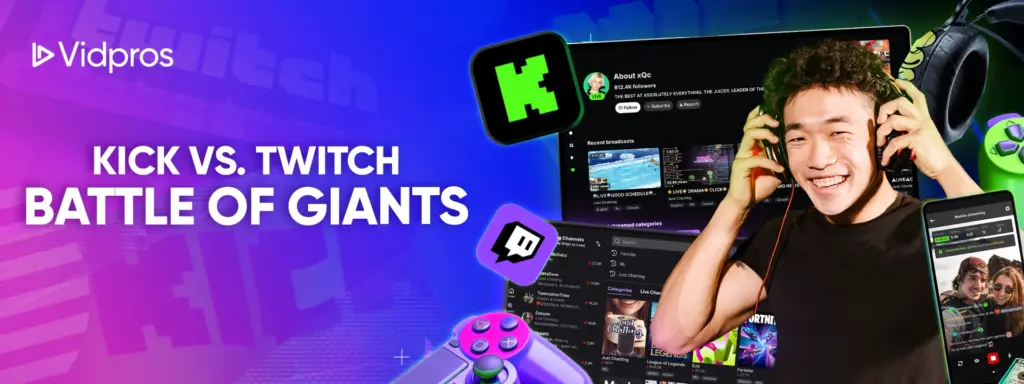
This means that for the exact same level of support from the audience, creators are making almost double, which is precisely why this model has garnered so much attention in such a short time, even though it was only introduced in 2022.
Since its launch in 2022, Kick has heavily emphasized its ‘creator first’ approach and made it clear that its goal is to ensure content creators’ earnings are higher, and they take a greater share of what they produce.
But…Making more per sub does not necessarily mean making more overall.
Kick is still in a growth phase, which means that the audience, although growing, has not yet reached the same scale as other platforms.
So, creators find themselves in a situation in which they make more money from each supporter, but have fewer supporters in total.
In some cases, creators find that they make about the same, or even less, than they might have made elsewhere, even though the revenue split is more favorable.
That does not mean, however, that the opportunity itself does not exist, because it absolutely does.
For creators who are smaller, the barrier to making money may be lower, and for creators who are mid-tier, the ability to scale more efficiently can be a major advantage.
The platform itself, however, is still evolving, still expanding, and still figuring out what it wants to do in the market.
THIS HUB WILL GROW
FAQ
1. Which platform pays creators the most per view?
Generally speaking, YouTube pays the most for views through ads.
This is because YouTube is a more mature platform with an existing ad system that pays creators through CPM (especially for longer-form content)
Other platforms, such as TikTok and Instagram, do pay creators for views, but the pay is significantly less. The majority of creators on these platforms make the real money through different income streams:
- Brand deals
- Sponsorships
- Affiliate links
So while TikTok might provide you with more views, YouTube might provide you with more pay-per-view.
2. How many followers do you need to start earning?
On YouTube, you can start earning through the YouTube Partner Program once you reach around 1,000 subscribers and 4,000 watch hours (or equivalent Shorts views).
You might also like: YouTube Shorts monetization in 2026: How much money you can make
While you don’t need a lot of followers to earn money on TikTok, you will need 10,000 to be eligible to earn money through the Creator Rewards Program (which replaced the TikTok Creator Fund). However, many people earn money on TikTok before they have 10,000 followers through brand deals.
While there is no follower count limit on Instagram’s side when it comes to monetizing your account, most social media influencers start getting brand deals around 5,000-10,000 followers, especially when engagement is high and the niche is obvious.
Monetization on Twitch usually begins when you achieve Affiliate status, which can begin at a lower level, such as 50 followers and consistent stream activity.
On Kick, you can start earning as soon as you have subscribers due to their 95/5 split, and there is no high follower count requirement like some other platforms.
3. Can you make a living as a full-time creator?
Of course, many people do earn a full-time living, but it’s rarely from one of these sources. It’s usually a combination of:
- Ad revenue
- Sponsorships
- Subscriptions
- Donations
- Sales
And yet, many people, even with similar content to you, might be making little to no money at all.
So, yes, it is possible to earn a living, but it’s really not dissimilar to running a business.
4. What’s the difference between CPM and RPM?
This is one of the biggest ideas to understand if you want to know how people actually make money.
- CPM (Cost Per Mille) = the price advertisers pay per 1,000 ad impressions
- RPM (Revenue Per Mille) = the actual revenue earned per 1,000 views
So, the CPM is really about the advertiser side, and the RPM is really what you want to care about.
So, for example, if you’re on YouTube, your CPM might be $10, and your RPM might be something like $4 or $5 after YouTube takes its cut and factors in the monetized views.
So, to break it down even further:
- CPM = what the advertisers pay
- RPM = what you get
And the one you want to actually care about is the RPM.
Finally…
If there is one thing that the entire breakdown proves, it is that the amount that content creators earn is never really about the platform.
Yes, some platforms pay more than others. Yes, some platforms offer better splits than others. Yes, some platforms offer better opportunities for creators than others. The reality is, though, that creators do not fail on the platforms; they fail on execution.
The best creators tend to focus on creating amazing content that actually holds attention, despite the type of platform they are in.
Better quality of production not only makes the content look better, it also makes it perform better. And when the performance of the content is maximized, more revenue.
Vidpros is based on this concept, and it can help creators improve the quality of their content in a manner that can help them grow by hiring fractional video editors. Check pricing or watch the demo if you need more convincing. (We’re also offering a $100 trial if that’s your kind of thing.)