Top Informative YouTube Channels
| Channel | Subscribers | Total Views | Videos |
|---|---|---|---|
| 7.6M | 2.4B | 515 | |
| 8.6M | 1.0B | 9,957 | |
| 9.6M | 983.0M | 1,170 | |
| 12.7M | 3.8B | 2,062 | |
| 15.4M | 6.7B | 6,109 | |
| 17.0M | 2.2B | 1,681 | |
| 20.5M | 4.1B | 492 | |
| 22.5M | 4.6B | 2,339 | |
| 25.2M | 3.6B | 350 | |
| 74.6M | 16.2B | 251 |


You know that feeling when you open YouTube to learn one thing, and 40 minutes later you’ve watched three half-explanations, two hot takes, and one video that somehow never gets to the point?
Same.
That’s why people search for the best educational YouTube channels. Not because they want more YouTube videos, but because they want clarity. They want educational videos that actually stick.
This list is subjective, obviously. “Best” always is.
But it’s not random either. These educational YouTube channels have a track record of taking complex topics and turning them into something you can actually explain to a friend. If you grew up watching Bill Nye, or you’ve ever used Khan Academy for a quick concept check, you already know the feeling you’re chasing. Simple, clear, and oddly satisfying.
Also, if you create your own videos, you’ll notice something else. The edit is doing a lot of heavy lifting. Pacing, structure, visuals, retention. It’s the stuff we nerd out on at Vidpros.
Best Educational YouTube Channels
Before we jump into the list, I’ll show you what I’m judging these channels by, so you can disagree with me in an informed, friendly way.
And I’ll give you three “start here” picks for each one, so you don’t get stuck scrolling.
What “Best” Means Here (And Why This List Still Helps)
Let’s be real. There isn’t one universal leaderboard for learning.
Some people want fast.
Some want deep.
Some want calm.
Some want pure entertainment that sneaks learning in.
So here’s the bar I’m using for the top educational YouTube channels in this article.
A great explainer channel can do three things consistently:
Make the topic feel simpler within the first minute. Even if it’s still complex, you feel oriented.
Build understanding step by step. A channel doesn’t teleport you into jargon.
Leave you with a clean takeaway. You can give a clear summary without sweating.
That’s it. No gatekeeping.
Also, a quick note on category overlap. Some of these are pure science. Some are journalism and politics. Some are psychology and philosophy. If you’re building a shortlist of the best YouTube channels for learning across different subjects, you’ll want a mix.
Top 10 Best Educational YouTube Channels (Recommended)
Before we start, one more thing.
If you’re expecting “perfect accuracy” from any creator on any topic, you’ll end up disappointed. Even great explainers simplify. They have to. A YouTube video is not a textbook or a full lecture series.
The goal is more useful than perfection:
You understand enough to think better, ask better questions, and know what to learn next.
That’s why these are my picks for the best educational YouTube channels for clear, engaging explanations.
Veritasium (20.4M subs)
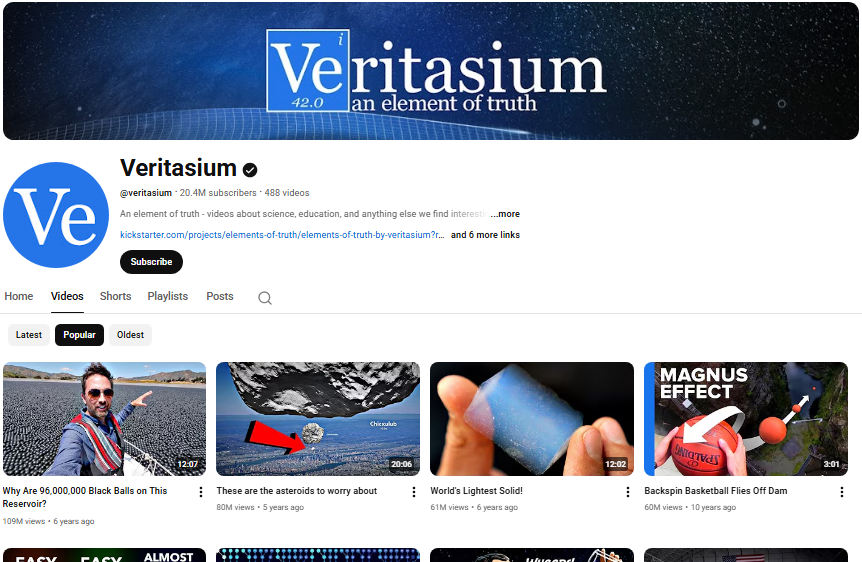
Best at: fixing misconceptions you didn’t know you had
Veritasium doesn’t just explain a concept. It usually starts by showing how people misunderstand it, then rebuilds the idea from the ground up.
That’s a powerful teaching move because most of us don’t start from zero. We start from wrong.
Also, Derek Muller is one of those creators who can be serious without being stiff. The vibe is “we’re figuring this out together,” and that’s a big reason viewers stick around.
Why does it explain so well:
It treats confusion like part of the story.
It uses experiments and real-world examples as proof, not just persuasion.
It’s patient. If an idea needs 20 minutes, it takes 20 minutes.
3 videos to start with:
This game theory problem will change the way you see the world
The Big Misconception About Electricity
I bought 1000 meters of wire to settle a physics debate
Kurzgesagt – In a Nutshell (25.1M subs)
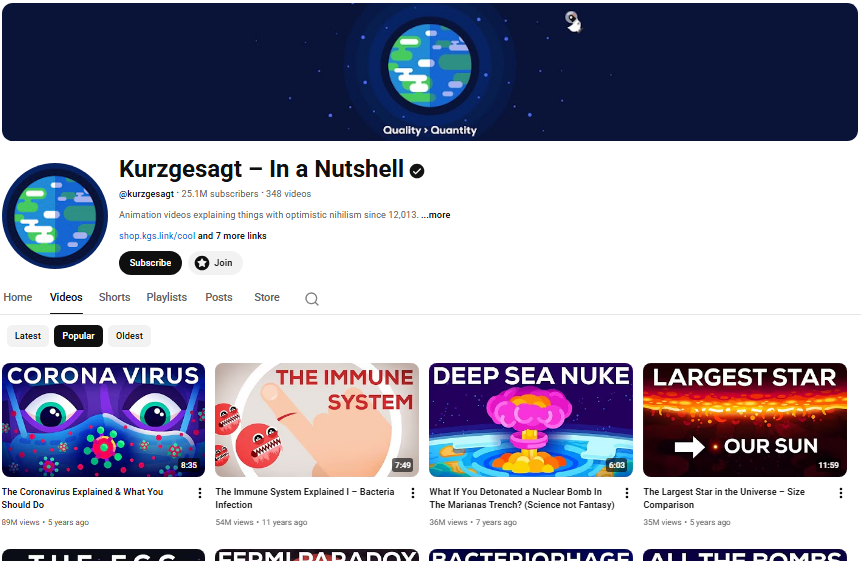
Best at: big science and systems topics that feel overwhelming
Kurzgesagt is the friend who can explain a scary topic without making you feel small. Yes, the animated videos are gorgeous. But the real magic is the writing and structure. You always know where you are in the explanation.
It’s also one of the few channels that publicly discusses being well-researched and how they fact-check. That transparency builds trust.
Why does it explain so well:
Strong “zoom level” control. It can zoom out without becoming vague.
Visual metaphors that stick. You remember the idea because you remember the picture.
A consistent voice. It’s calm, slightly existential, and weirdly comforting.
3 videos to start with:
The Fermi Paradox — Where Are All The Aliens? (1/2)
TED-Ed (22.5M subs)
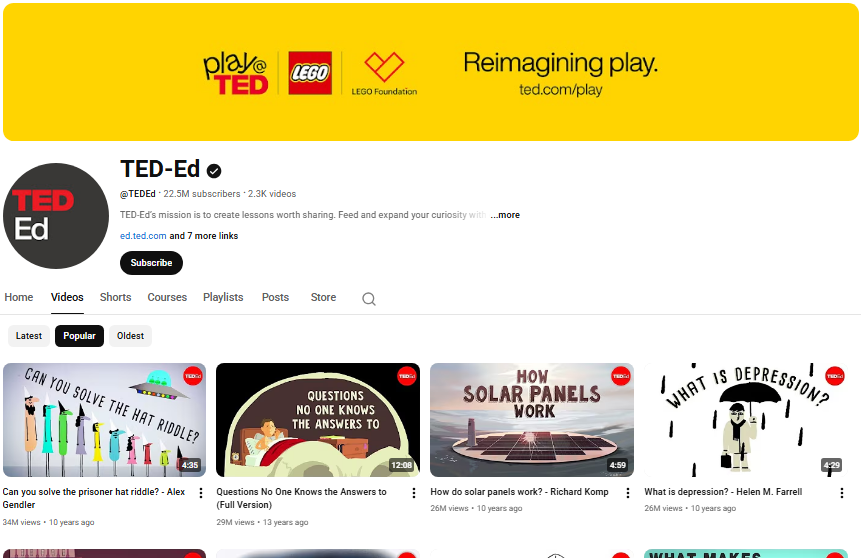
Best at: tight lessons that never wander
TED-Ed feels like the cleanest “one question, one lesson” format on YouTube. The scripts are sharp. The pacing is deliberate. The visuals follow the logic beat by beat, which is why TED-Ed is a cheat code for visual learners.
A lot of their stuff also plays like animated shorts. Short videos, high clarity, one clean takeaway.
Why does it explain so well:
Every lesson has a single spine. One question, one payoff.
The animation is there to teach, not to show off.
It’s built for rewatching. You can pause and still stay oriented.
3 videos to start with:
Why is it so dangerous to step on a rusty nail? – Louise Thwaites
Why can’t you put metal in a microwave? – Aaron Slepkov
Scientists are obsessed with this lake – Nicola Storelli and Daniele Zanzi
CrashCourse (17M subs)
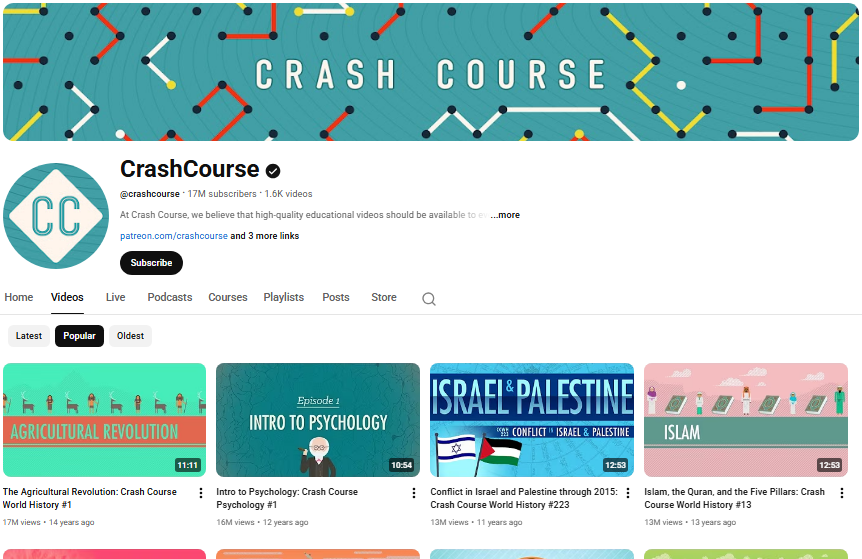
Best at: learning a subject like you’re taking a real class
Crash Course is what you recommend when someone says, “I missed this in school,” or “I want the basics, but I want them done right.”
It’s fast, but not careless. The speed works because the structure is so strong. It scaffolds the knowledge, then builds.
Also, the channel has real internet history behind it. Hank Green, John Green, and the whole Crash Course universe helped normalize the idea that educational YouTube can be both rigorous and fun.
If you’re looking for the best learning YouTube channels in the “teach me properly” sense, Crash Course belongs in the conversation every time.
Why does it explain so well:
It assumes you’re smart, but not pre-loaded with terminology.
It repeats key ideas in slightly different ways, which is how concepts stick.
It’s organized like a video series. You can follow a playlist and actually build knowledge over time.
3 videos to start with:
The Agricultural Revolution: Crash Course World History #1
Intro to Psychology: Crash Course Psychology #1
Carbon… SO SIMPLE: Crash Course Biology #1
Quick note: if you’re into social studies, world history, or even World War-era context. Crash Course has entire runs that make history feel less like memorizing dates and more like understanding systems.
Vox (12.7M subs)
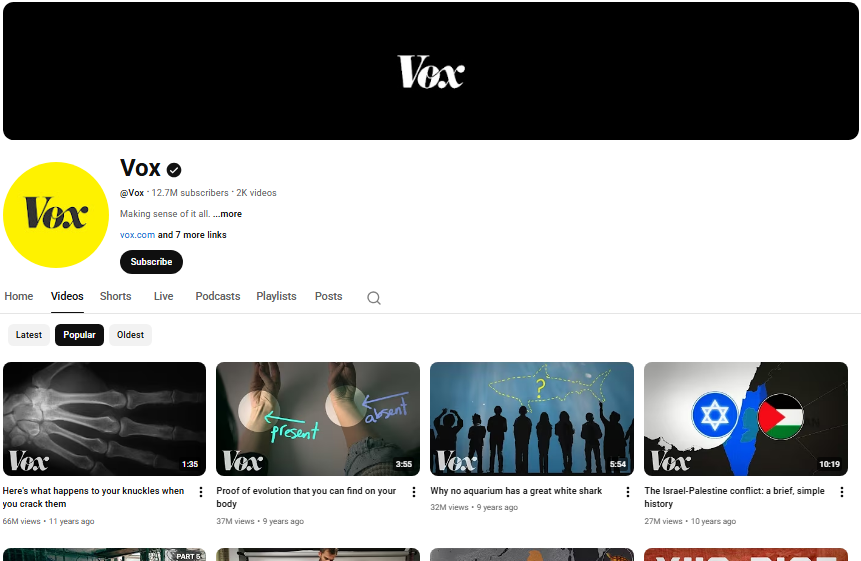
Best at: explaining real-world issues with visuals that make the “why” click
Vox is a masterclass in visual journalism.
A lot of channels can explain a concept. Vox explains a concept inside the messy reality it lives in. That usually means context, history, archives, charts, and very tight scripting.
You end up with a clear summary of a complex topic that still respects nuance. That’s hard to do, especially in politics, money, or tech policy.
Why does it explain so well:
It answers the second question people forget to ask: “How did we get here?”
The visuals do real work. Graphs and animation that clarify, not distract.
Strong narrative logic. It feels like a story with evidence.
3 videos to start with:
How the rich avoid paying taxes
Why US gun laws get looser after mass shootings
The REAL Reason McDonalds Ice Cream Machines Are Always Broken
Cleo Abram (7.51M subs)
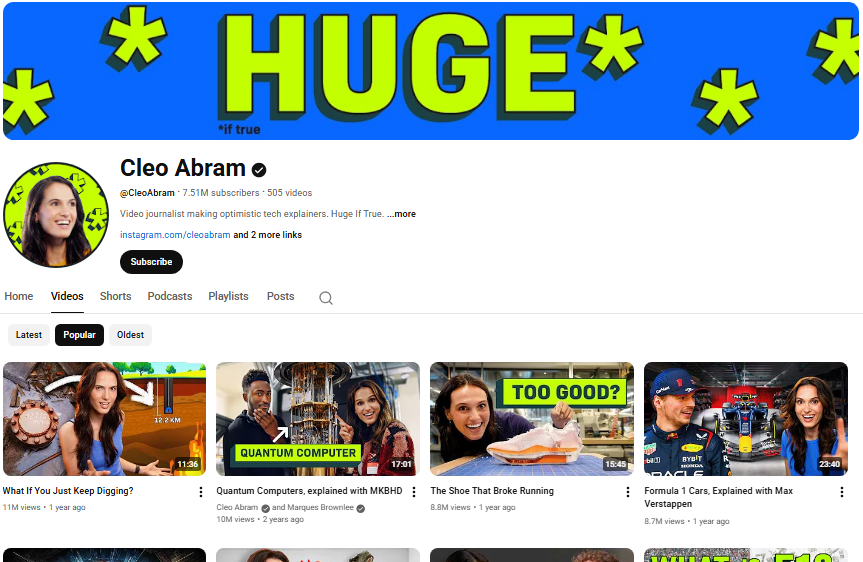
Best at: modern technology explained with curiosity and optimism
Cleo’s channel feels like the future version of explainers. Clean production, clear structure, and a tone that makes technology feel exciting instead of intimidating.
A lot of tech coverage swings between doom and hype. Cleo usually sits in a better lane: “Here’s how it works, here’s why it matters, here’s what’s real.”
Why does it explain so well:
Strong framing. You know the question and the payoff early.
Great pacing. It moves like a show, not a lecture.
Visual storytelling choices that match the topic. Animation when needed, field footage when it helps.
3 videos to start with:
What If I Fell Into A Black Hole?
Formula 1 Cars, Explained with Max Verstappen
Why This Olympic Sport Bothers Physicists
Mark Rober (73.7M subs)
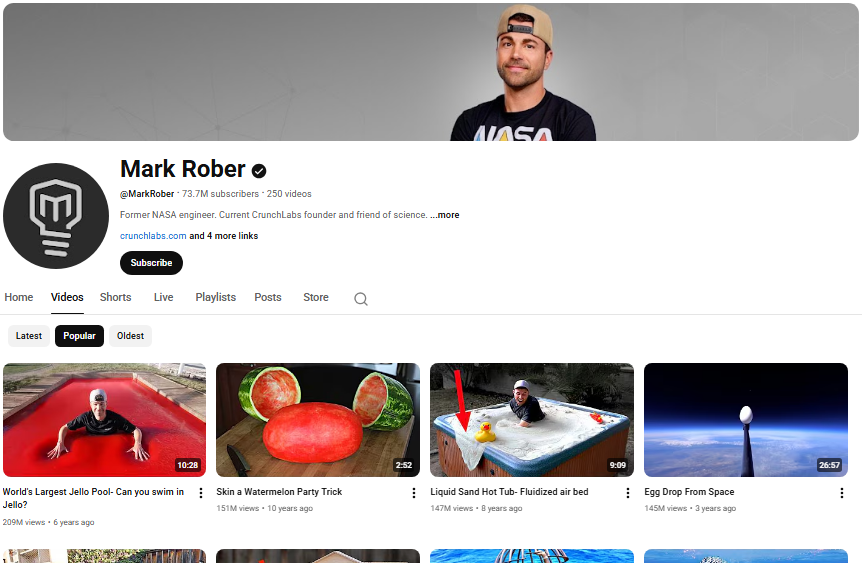
Best at: making science feel fun without dumbing it down
Mark Rober is the channel you send to someone who “doesn’t like science,” and then they accidentally learn scientific principles while laughing.
His content centers on science experiments, engineering projects, and creative builds. The production is high, the storytelling is entertaining, and the explanations are designed for normal humans.
Notable background that actually matters here:
He’s a former NASA and Apple engineer, known for glitter-bomb prank videos, the world’s largest Nerf gun, and collaborations with MrBeast.
Why does it explain so well:
The project is the explanation. You see the scientific concepts in action.
The stakes are clear. There’s always a reason to care.
The edits are clean and intentional. It never feels bloated.
3 videos to start with:
Glitter Bomb 1.0 vs Porch Pirates
Saving Our Oceans With a LEGO Machine
Big Think (8.31M subs)
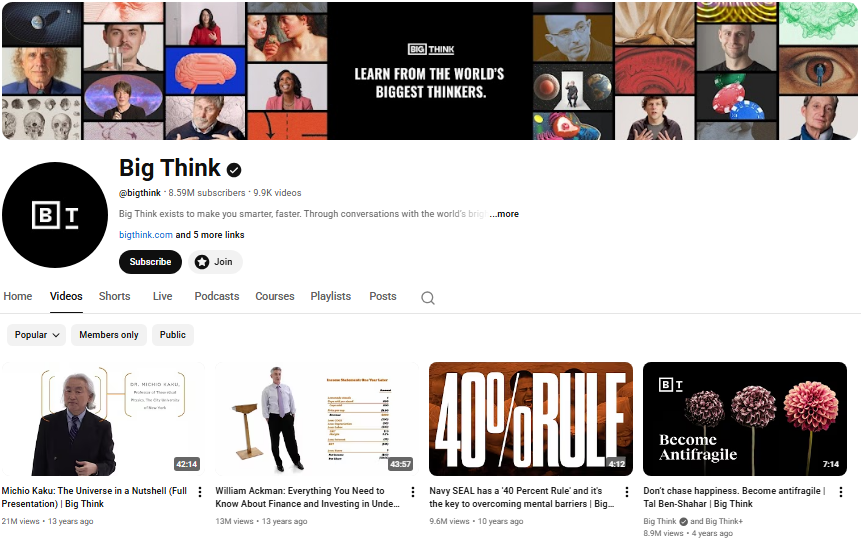
Best at: expert ideas turned into digestible takeaways
Big Think is a different kind of explainer. It’s less “one creator teaches you everything” and more “smart people explain their best ideas, and the edit makes it clear.”
If you like learning from experts but don’t want to sit through a 90-minute lecture every time, this is a strong middle ground.
Why does it explain so well:
It compresses complex ideas without flattening them.
The questions are sharp, which pulls sharper answers.
You can watch in five minutes and still walk away with something useful.
3 videos to start with:
Why haven’t we found aliens? A physicist shares the most popular theories. | Brian Cox
Don’t hire the smartest job candidate | Tyler Cowen
How psychedelics work, explained in under 6 minutes | Matthew Johnson
The School of Life (9.61M subs)
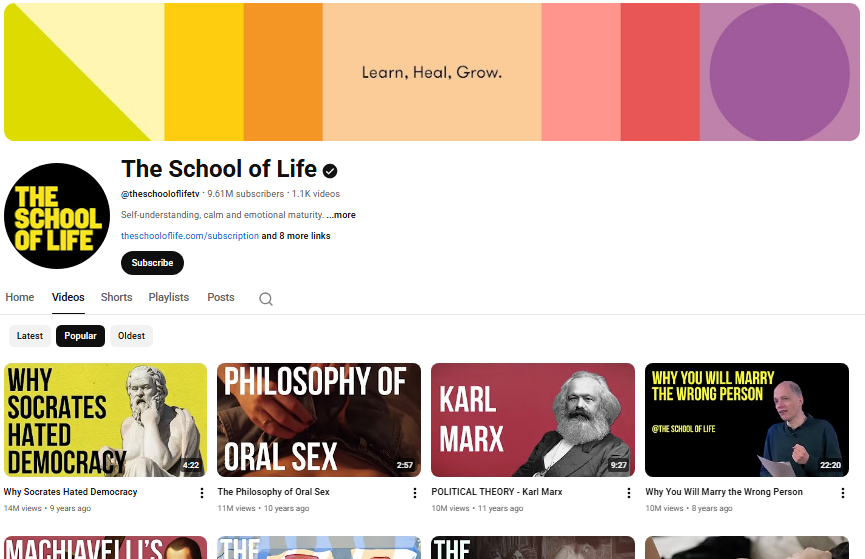
Best at: explaining emotions, relationships, and the “why am I like this” stuff
The School of Life sits in a lane most educational channels ignore: emotional education.
Its content covers philosophy, psychology, relationships, self-improvement, workplace psychology, and the history of ideas. The style is usually animated explainers with calm narration, and it’s meant to be thought-provoking rather than frantic.
Notable background:
Alain de Botton founded it, and the channel’s voice reflects that. Philosophical, gentle, and surprisingly practical.
Why does it explain so well:
It makes abstract feelings concrete. That’s harder than it sounds.
The pacing gives ideas room to land.
It uses relatable examples that feel like real life rather than case studies.
3 videos to start with:
The Eight Rules of The School of Life
20 Signs You’re Emotionally Mature
The Infographics Show (15.4M subs)
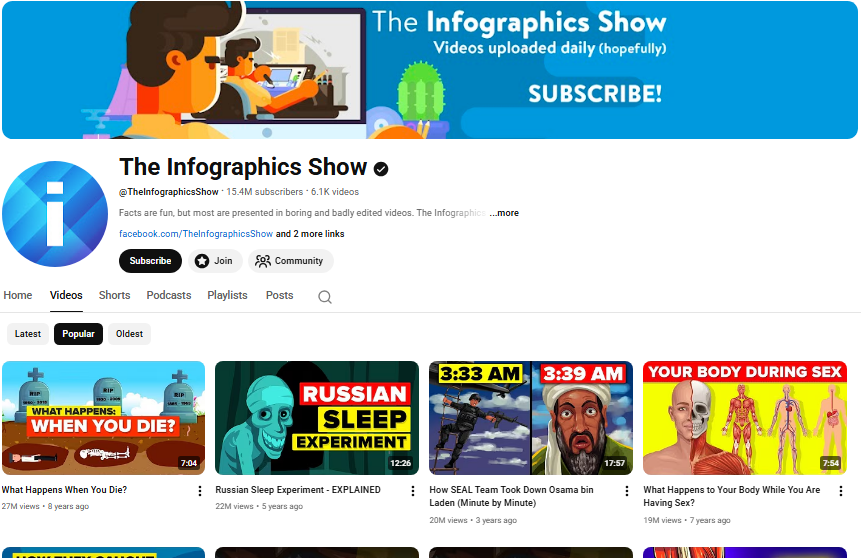
Best at: fast, accessible animated explainers that keep you oriented
The Infographics Show is the high-output animated explainer machine, and it’s popular for a reason.
It often uses “what if” scenarios and straightforward narration to guide you through complex topics quickly. Some videos are more of an overview than a deep dive, but the clarity is usually strong.
I think of it as a gateway channel. It gets people curious. Then they go deeper elsewhere.
Why does it explain so well:
Simple language and clean sequencing.
Visual scaffolding that keeps the story easy to follow.
Hooks that create instant stakes.
3 videos to start with:
WHAT TO DO IF THERE IS A NUCLEAR EXPLOSION?!
Could You Live At The Bottom Of The Mariana Trench?
What If a Whale Accidentally Swallowed You?
The Formula for The Best Explainer YouTube Channels
Most “explainer” videos fail for one boring reason.
They skip the part where your brain needs a map.
They start mid-sentence, assume context, and you spend the first three minutes mentally whispering, “Wait… what are we talking about?”
The best explainer YouTube channels do the opposite. They pay the clarity tax upfront. That’s why their YouTube content feels effortless to watch, even when the topic is not.
Here’s the formula I see across the best ones.
A quick way to spot a good explainer fast
If a video does these five things, it usually lands.
The hook is a real question, not a trap:
It doesn’t just tease. It frames a problem your brain wants solved.
The structure is obvious:
You can feel the path. Set up, explanation, payoff. Even in short videos, you know where you are.
The visuals carry meaning:
Charts, animation, or experiments that explain, not just decorate. This matters a lot for visual learners.
The language is friendly:
Short sentences when needed. Terms are defined quickly. No “I’m smart, and you’re lucky I’m here” energy.
The edit respects your attention:
They cut dead space. They repeat key points in a new way. They let you breathe when the idea is heavy.
How to Choose the Right Channel for You (Without Overthinking It)
At this point, you might be thinking, “Cool list. But I don’t want ten subscriptions. I want three.”
That’s the right instinct.
Here’s how I’d pick based on what you want to learn and how you prefer to learn.
Pick based on your topic lane
Start here:
For science and nature type learning: Veritasium, Kurzgesagt, Crash Course
For technology and big questions about the future: Cleo Abram, Kurzgesagt, Big Think
For politics and real-world systems: Vox, Cleo Abram
For psychology, relationships, and life stuff: The School of Life, Crash Course Psychology, Big Think
For broad education that’s easy to share with students: TED-Ed, Crash Course
For extra practice at specific grade levels: Khan Academy is still one of the most useful education YouTube channels in existence, even though it’s not in this particular top ten
If you’re specifically hunting for science education YouTube channels, you can’t go wrong starting with Veritasium, Kurzgesagt, and Crash Course.
Pick based on your attention style.
This part matters more than people admit.
If you like fast and structured, go to Crash Course, Vox, TED-Ed.
If you like story and spectacle, go to Mark Rober and Veritasium.
If you like calm and reflective, go to The School of Life.
If you like expert brain fuel, go Big Think.
One more quick heuristic.
If you finish a video and you can summarize it in one sentence, it was probably a great educational video.
Next up, I’ll give you starter packs so you can stop searching and start watching videos.
Quick Starter Packs
This is the part that saves you time.
Because the hardest part of learning on YouTube is not the learning. It’s picking the first video.
Here are a few mini-playlists to get you started. If you’re trying to build a habit, these work better than random scrolling.
Starter pack for science clarity
Veritasium: The Big Misconception About Electricity
Kurzgesagt: The Fermi Paradox (Part 1)
Crash Course: Carbon… SO SIMPLE
These three cover misconceptions, systems thinking, and foundations like biology and chemistry logic. That’s a strong week.
Starter pack for real-world explainers
Vox: McDonald’s Ice Cream Machines
Cleo Abram: Formula 1 Cars Explained
TED-Ed: Why can’t you put metal in a microwave?
This mix is great if you want educational content that feels relevant, not like homework.
Starter pack for human psychology
The School of Life: Who Am I?
Crash Course: Intro to Psychology #1
Big Think: Don’t hire the smartest job candidate
If you’re building a personal list of favorite YouTube channels, starter packs like this make it way easier to find your actual favorites without overthinking it.
And if you’re collecting top educational YouTube channels to share with students, educators, or coworkers, playlists help because people try one link rather than a whole channel.
Why These Channels Keep Ending Up on Everyone’s List
Here’s my honest take.
Even though this list is subjective, most of these names keep showing up because they’ve built repeatable systems for clarity.
They’re not relying on vibes.
They have formats.
They have editing patterns.
They have a way of sharing information that makes complex ideas feel followable.
That’s why if someone asked me for the best explainer YouTube channels, I’d still send them most of this list. It’s hard to argue with clear structure and well-researched storytelling.
Want Explainer-style Edits Without Doing the Editing?
If reading this list made you think, “Okay… I should probably step up my pacing, visuals, and structure,” you’re already on the right track. The best educational YouTube channels don’t win because they have better ideas; they win because they package those ideas in a way people can follow all the way to the payoff.
And if you don’t want to edit that yourself, Vidpros can help. We offer a $100 trial that gets you one week of professional video editing. You can use it for 10 short-form videos or 1 long-form video, depending on what you’re publishing right now. It’s an easy way to see what tighter cuts, cleaner flow, and more intentional pacing feel like on your own content, and it usually makes the next videos faster and easier to produce, too.
Either way, you’ve got a solid watch list and a clear next step.
Frequently Asked Questions
What are the best explainer YouTube channels for clear visuals?
If visuals are your main learning trigger, I’d start with:
Kurzgesagt for animated videos and systems thinking
TED-Ed for lesson-style animation that follows the logic
Vox for charts, archives, and visual journalism
What are the best educational YouTube channels for students?
For structured learning, Crash Course and TED-Ed are usually the easiest wins. Crash Course is the closest thing to a real course sequence. TED-Ed is perfect for shorter lessons and discussions.
What are the best science education YouTube channels for adults?
Adults usually want science that respects their intelligence and their time.
Start with:
Veritasium for misconceptions and experiments
Kurzgesagt for systems and big picture science
Crash Course for foundations you can build on
If you’re curating science education YouTube channels for a group, that trio covers most learning styles.
Are animated channels less accurate?
Not automatically.
Animation can be incredibly accurate if the scripting and research are solid. It can also be misleading if it oversimplifies or skips uncertainty.
A better signal is this. Does the channel show its work through sources, experts, demonstrations, or consistent logic?