If you are trying to get something to work, and you figure out you are doing tech support yourself, I understand. One moment, you are set to talk. The next moment, you are going through a list of audio problems, trying to figure out screen sharing, and trying to figure out what a “wrong device” message is.
So, what is StreamYard?
StreamYard is a browser-based live streaming platform, so there is no need to download anything. It has the capabilities of a simple broadcast studio, and you can host live streams, as well as record shows with guests, add your own branding to the videos, and stream or record to social media platforms. Acceptable platforms include YouTube, Facebook, LinkedIn, and Twitter, to name a few. Guests can join your stream by simply clicking a link you provide, and they don’t have to download anything.
Also, real talk. Getting a clean StreamYard recording is step one. Turning that recording into scroll-stopping clips is step two. If you are trying to create good clips, you are saving a lot of time by getting an editor. Here at Vidpros, we have a lot of people who use their services for that reason.
This guide covers what StreamYard does, how it works, the features that actually matter, what’s free vs paid, and when you might pick a different tool.
What StreamYard is (and what it’s not)
Before we get into the fun stuff, it helps to set expectations. StreamYard is popular because it removes friction. It makes streaming feel doable for normal people with normal schedules.
What StreamYard Is
StreamYard is a simple, hassle-free streaming platform that lets you start your first live broadcast or webinar straight from your browser with no prior streaming experience, as it is explicitly designed for quick and easy use. First, you create a studio, then add guests, choose your desired style, and brand your stream before heading live to YouTube or your preferred streaming service.
Ever thought, I just want to start streaming, and I don’t want to turn this into a project? Well, StreamYard is built for that.
What StreamYard is Not
Admittedly, this is not an indictment of StreamYard; it is just honest framing so you do not set your expectations too high.
StreamYard is not:
A fully customizable production switcher for those who want deep scene control and sophisticated audio routing
A meeting-focused app, a la Zoom, where the goal is to facilitate internal calls
A replacement for basic essentials like decent lighting and decent audio
StreamYard is a solid choice if you want a simple weekly show you can easily replicate time and time again. You will get more out of a steady routine than a “perfect” setup you will only use once.
Now that the definition is set straight, the next question is often the only question that matters. What can it do?
What is StreamYard Used For? Real Examples
Most people googling “what is StreamYard” aren’t trying to become streaming experts. They want to look professional in front of the camera without wasting time learning complicated software to achieve their goals.
The following are the ways StreamYard may be employed by creators and businesses, along with examples to consider.
Here are the ways StreamYard may be utilized effectively:
Weekly Q and A: A founder to engage with the audience in live Q&A sessions.
Podcast-style interviews: Record and edit podcasts with remote participants.
Product demos: Motivate the audience by sharing your screen and doing a walkthrough of the process.
Webinars and trainings: Conduct a live teaching session and use the recording for future reference.
Panel discussions: Invite and rotate multiple guests on the screen.
Multi-platform events: Run one show and stream to multiple channels on paid plans
Content repurposing: One long conversation becomes YouTube plus short clips for other platforms
A quick personal opinion: StreamYard works best for conversation-based content. Interviews, panel chats, customer stories, weekly live updates. If your show needs constant scene switching and advanced production tricks, you can still make it work, but StreamYard isn’t trying to be that kind of live streaming software.
Now you’ve got the what and the why. Next, let’s keep the process simple, because that’s the point.
How StreamYard Works (high-level walkthrough)
While this isn’t a full tutorial, it’s the process you’ll use over and over. Once you understand this loop, StreamYard becomes very “set it up once, then reuse it forever.”
Step 1: Create a stream or a recording
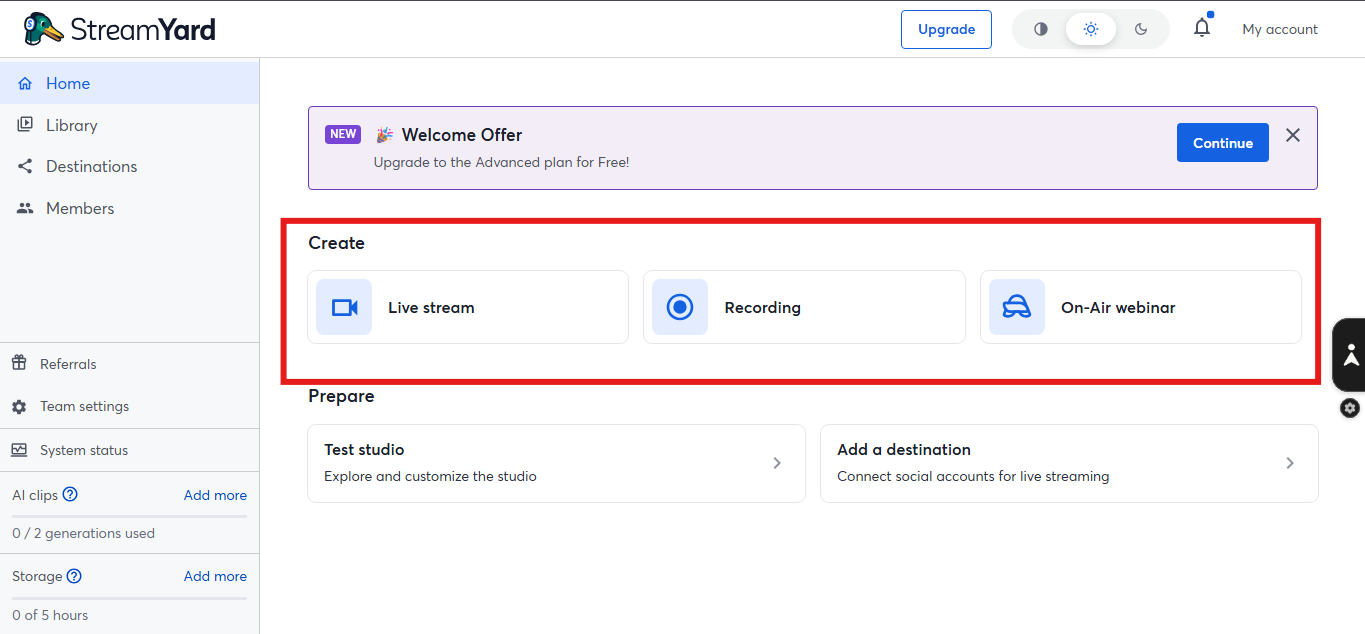
You start by creating a new session that can either be a live stream, a recording session, or an on-air webinar. You enter the studio after creating a name for the session and setting some basic configurations.
You will notice StreamYard keeps you in a browser-based studio. This means there won’t be a need for additional downloads or complicated installation.
Step 2: Choose your destinations
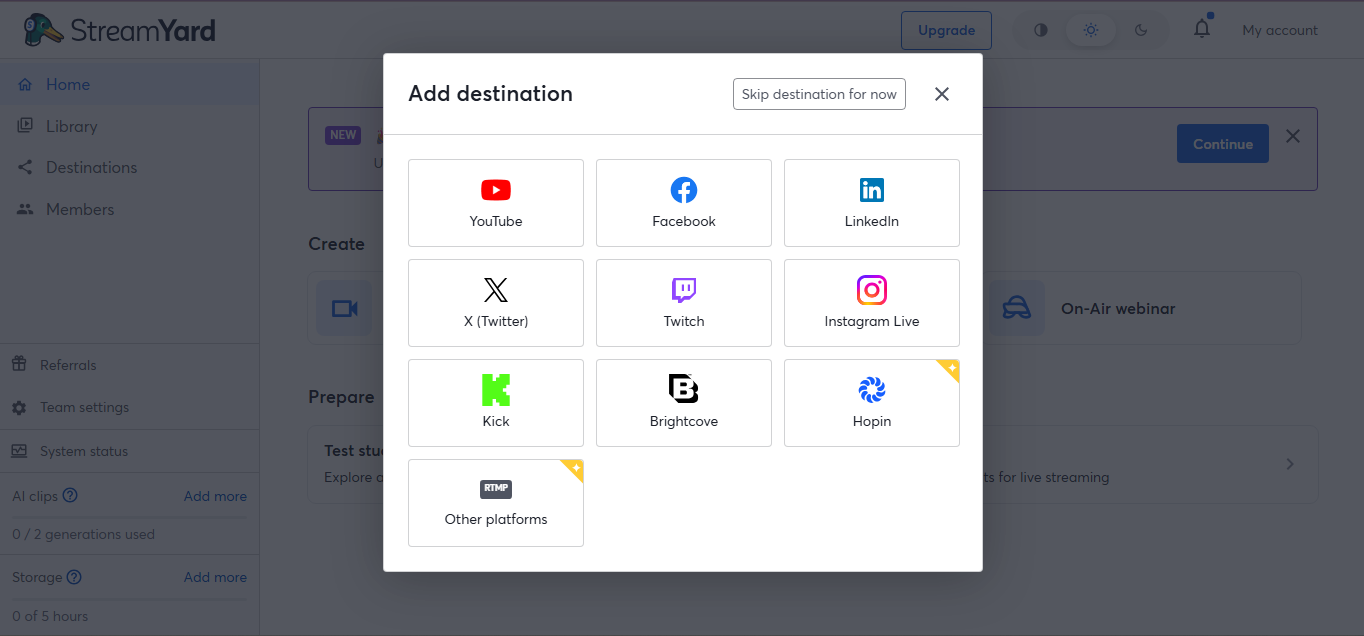
StreamYard uses the word “destinations” for where your stream goes. A destination might be your YouTube channel, a Facebook page, LinkedIn, or another platform.
Here’s the quick rule that saves confusion:
Free plan: stream to 1 destination for up to 20 hours per month
Paid plans: stream to multiple platforms at the same time, depending on your plan, for as long as you’d like
If your strategy is “go live everywhere,” this is usually your first upgrade trigger.
Step 3: Invite guests with a link
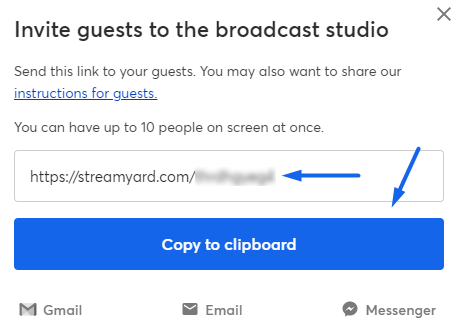
This is one of StreamYard’s best features. Guests join via a link. They don’t need a StreamYard account.
When you have a guest who is busy, not tech-savvy, or holding an older laptop, your consideration here is significant. It alleviates “install this, create an account, set up permissions” obstacles.
To make the interviews go more smoothly, I suggest a pre-flight. It may sound like a lot, but it is what differentiates a calm show from a show that is pure chaos.
Guest pre-flight checklist:
Browser: Use Chrome or any up-to-date browser.
Audio: Use headphones if you can.
Lighting: Get lit from the front, not the back, with a window.
Connection: Good internet is important for video and audio.
Step 4: Build your layout and visuals
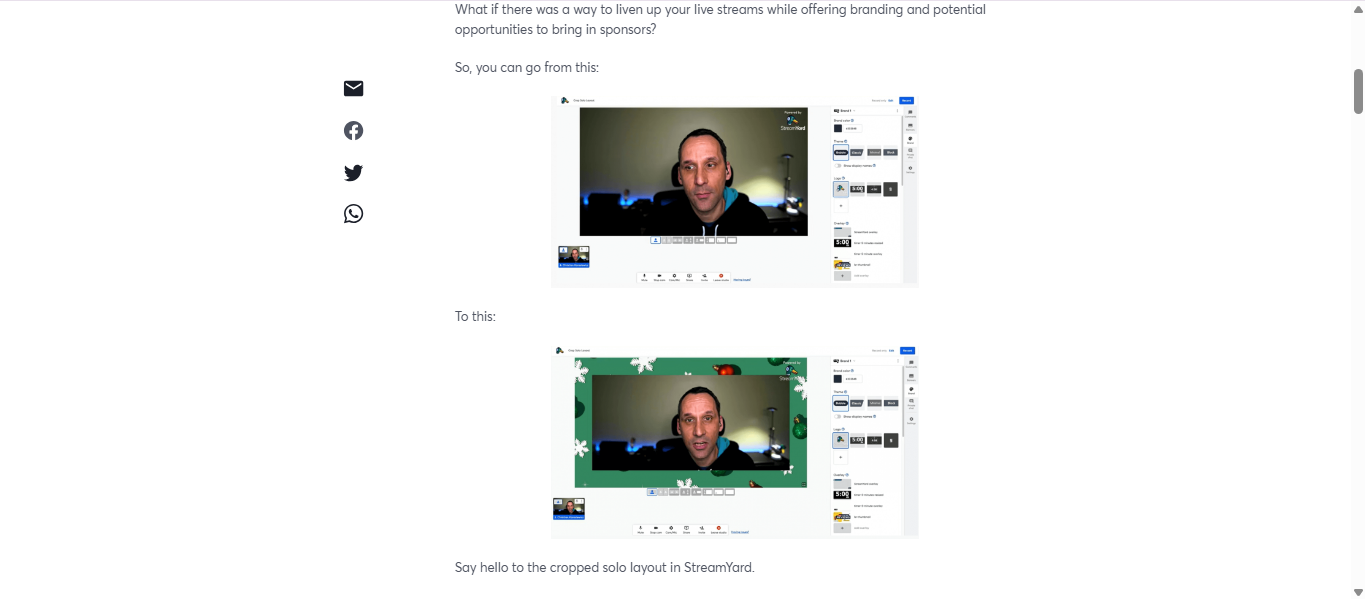
This is where StreamYard feels like a broadcast studio, not a video call.
You can:
Choose a layout with one host, two hosts, and a panel
Create name tags and lower thirds.
Display your logo, background, and banners
Share your screen for slides and demos
Display images or videos
This is the part that saves you the most time. Once you design a look, you can use it again and again.
Step 5: Go live or hit record
When you go live, StreamYard sends your live broadcast to your destination. When you record, you capture a recording that you can edit into videos and clips later.
If recording and downloads are central to your workflow, treat that like a non-negotiable and choose the plan accordingly.
Now that you understand the workflow, let’s talk about features. Not everything. Just the ones that actually make StreamYard useful for real-world streaming.
The StreamYard Features That Matter
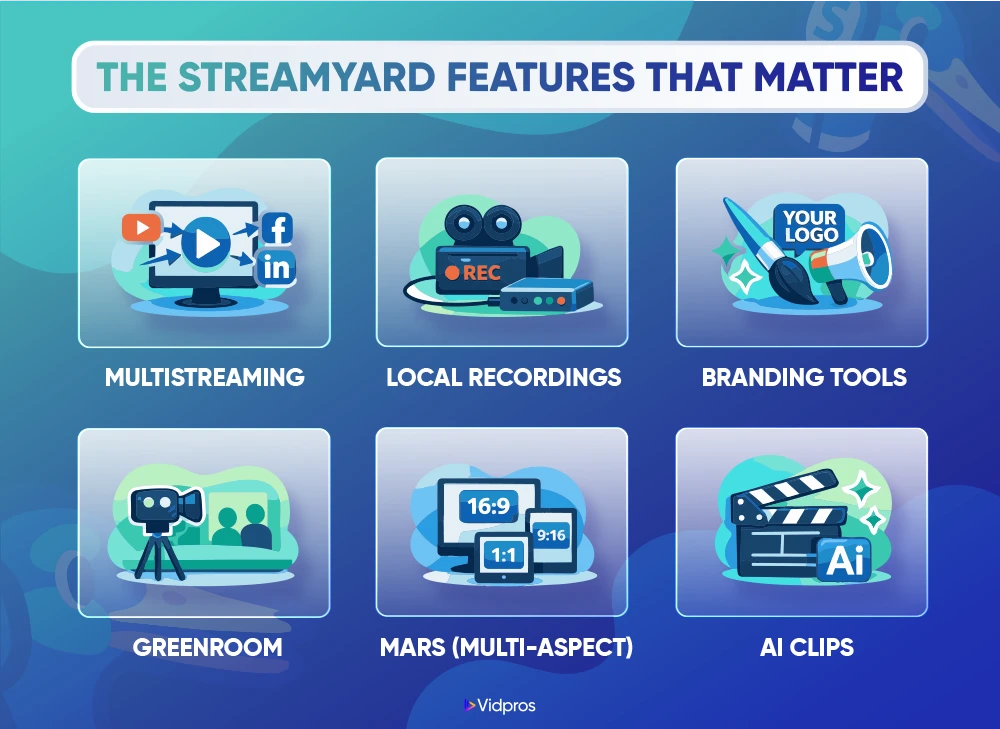
StreamYard has a ton of features, but most customers only use a small handful that save the most time and give the most professional look. This section talks about what really makes a difference to your experience as a host.
StreamYard multistreaming
StreamYard multistreaming is the ability to go live on several platforms at the same time. This is a big deal if your audience is divided between more than one social media account.
Why is StreamYard multistreaming helpful?
Your target audience can watch you live on the social media account they prefer.
You can go live on multiple social media accounts, so you do not have to choose and leave one out.
You can run one live stream and use multiple social media accounts.
StreamYard limits the number of destinations you can stream to based on your pricing plan. On the free plan, you can stream to one destination only, but with the paid plans, you can stream to more than one destination, depending on the StreamYard pricing plan you choose. Three destinations for the Core Plan and up to eight destinations for the Advanced Plan.
In my opinion, multistreaming is great, but you can sometimes have the tendency to overdo it. I recommend keeping it to a maximum of 2 or 3 different social media platforms to give you the most reach while keeping the moderation requirements to a minimum.
Local recordings (quality boost for recorded interviews)
Local recordings are another one of those StreamYard features that feel boring until you actually need them. The way this works is that every participant records a separate audio and video file on their device, and those files can be uploaded during the recording.
Why that matters:
If a guest’s connection dips, your final recording can still look clean
You get better source quality for editing
It’s especially useful when you want to pull clips later
This is a perfect example of StreamYard making a professional workflow feel simple. You can record podcasts and interviews and hand them off to an editor without stressing about choppy footage.
Branding tools
Your stream can uniquely represent you and your brand instead of feeling like a random video chat.
The branding tools available from StreamYard include:
Logos and overlays
Lower thirds and name tags
Banners and tickers
Backgrounds and themes
Branding is meant to enhance your stream and not steal the focus, so I like a simple banner, and just a single lower third will suffice for most people.
Greenroom (guest management for important streams)
The Greenroom is a place to ensure guests can be prepped, and order is maintained before they appear on screen. This is used for streams where timing is important.
Greenroom is great for:
Panel shows that have guests waiting to enter.
Sponsor addresses that need to stay neat and tidy
Shows with audio checks before going live.
Broadcasts that need to minimize surprises.
If you’ve hosted and seen a guest join late and confused, you know exactly why this is important.
Multi-Aspect Ratio Streaming (MARS)
As for MARS, Multi-Aspect Ratio Streaming, it’s for the modern content reality, as you probably want a landscape stream for YouTube, but vertical for Shorts, Reels, and other mobile-first formats.
So, multi-aspect ratio streams enable you to produce once and distribute smarter, but keep in mind that broadcasting to more than one format will impact destination counts. Generally, it’s a paid function.
Audience engagement
StreamYard supports ways to display chat comments on screen, which is perfect for Q and A, demos, and community streams.
Just one fair note: chat and comment behavior can differ across platforms. If your show is a comment-centric stream, make sure to test it on the platform you’ll be using, especially if streaming across multiple platforms.
Repurposing helpers (AI clips)
As for the repurposing helpers, StreamYard has tools to assist in generating AI clips from longer recordings.
My take: It does good work for a first draft of highlights. You’re still going to want a human pass to tighten pacing and ensure the hook is strong. Most great clips aren’t just “a good moment.” They’re a good moment that starts quickly and ends clean.
StreamYard features are cool, but the majority of people decide for a pretty basic reason. Is StreamYard free, and what do you actually get before you pay?
StreamYard Pricing
Yes, StreamYard is free to start, and it’s a real free version. You can go live. You can test a format. You can get comfortable with the studio. You just need to know the limits so you don’t build a whole strategy and hit a wall later.
What you can do on the free version
The free plan is a good starting point if:
You want to stream live to one platform
You’re testing your show format
You’re recording occasionally, within free limits
You’re keeping the production simple with a small group of guests
This is how I like to use it: treat the free plan as a proving ground. Get one show live. Get your setup stable. Build the habit.
When paid plans make sense
Most users upgrade when they feel one of these pressures:
Upgrade triggers:
Multi-stream to multiple sites simultaneously.
More capacity to include more guests, layouts, or branding.
Wish to have saved recorded live streams in StreamYard, and want to have the option to record and download.
Need business or agency team workflows to set up.
Want more advanced options, such as Greenroom.
StreamYard also makes plan management straightforward. You can cancel anytime and keep paid access until the end of the billing cycle.
Billed Monthly
Core – $25/month
Advanced – $49/month
Billed Yearly
Core – $20/month
Advanced – $39/month
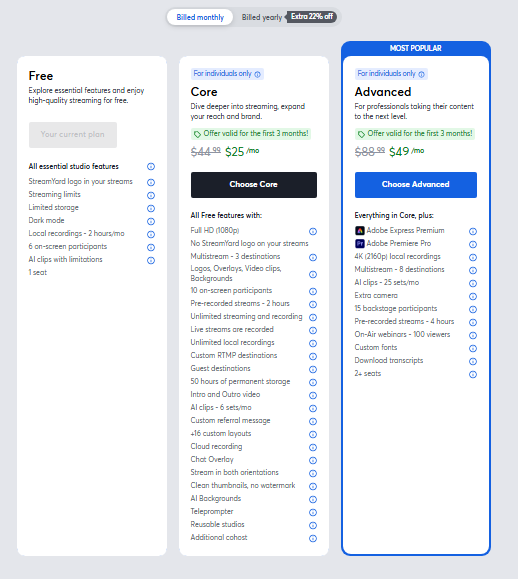
Pricing changes, promotions, and renewal rates can also vary. So, I appreciate a more practical way. The most practical way to deal with pricing is to refer to StreamYard’s pricing page to review what the current pricing is.
Pricing is only a part of your decision. The question that you should really be asking is what is the best fit. Who derives the most value from StreamYard and why?
Best Fits by Persona
StreamYard can be effective for many people, but it can be especially effective for specific types of teams and styles of content. Here’s how it fits with the personas we find the most important.
Small business owners
If you are looking for weekly consistency, StreamYard is the best option. It diminishes the time needed for the complicated setup, so you can focus on your content.
Here’s a simple workflow that works:
One weekly live stream, lasting 30-45 minutes
Pull 10 to 20 clips over the next two weeks
Post 2 to 3 short videos per week across platforms
Reuse one segment as a standalone video for your YouTube channel
This may be straightforward, but it’s super effective. Consistency is key.
Marketing managers
StreamYard fits because it supports repeatable productions, and marketing teams usually need systems.
For Example:
Launch live streams with a consistent branded template
Partner interviews that double as co-marketing
Webinars and trainings that become evergreen videos
Short clips for paid and organic campaigns, repurposed
The hidden win is speed. Less time fighting with the tools means more time crafting the message.
Agency owners
Agencies love anything that clients can use without the risk of breaking anything.
StreamYard helps because:
Guests can join by just clicking a link
Clients don’t have to download an app
You can make brand-specific studio templates that can be used over and over again
You can record and give your footage to an editor to upload the footage really easily
In my opinion, agencies spend more time in coordination than actual editing, and anything that makes guest setup easier is really helpful.
StreamYard vs OBS vs Restream vs Zoom
This section is intentionally short. It’s here so you can decide fast and move on.
StreamYard vs OBS
OBS gives you deep control. It can also become a hobby.
If you want simplicity, guests by link, and a user-friendly broadcast studio, StreamYard usually wins. If you want maximum control over scenes, plugins, and advanced audio routing, OBS is often better.
StreamYard vs Restream
Restream is widely known for distribution. StreamYard is more studio-first and guest-first.
If you care about a smooth guest experience and a simple way to create live video, StreamYard tends to feel easier. If your priority is distribution-first features, compare both.
StreamYard vs Zoom
Zoom is meeting-first. StreamYard is broadcast-first.
If you want a show feel with branding, layouts, and on-screen chat comments, StreamYard fits better. If you primarily run internal calls and only stream occasionally, Zoom might be enough.
Even with the right tool, a few common mistakes can make streaming feel harder than it needs to be. Here’s how to avoid the usual pain.
Common Mistakes (and quick fixes)
Most StreamYard issues aren’t really StreamYard issues. Their production habits. The good news is the fixes are simple.
Mistake 1: Multistreaming without a moderation plan
If you stream live to multiple platforms, chat can get scattered across multiple channels.
Quick fix:
Start with one or two platforms
Assign someone to monitor chat and comments
Use one clear call to action so viewers know where to engage
Mistake 2: Ignoring audio
Bad audio kills retention. Even a great video can’t save it.
Quick fix:
Use a USB mic if you have one
Wear headphones to reduce echo
Keep the mic closer than you think
Mistake 3: Skipping a guest test
Guests frequently show up with the wrong mic selected. It’s normal.
Quick fix:
Have guests join 5 to 10 minutes early
Confirm mic, camera, and browser access before you start
Mistake 4: Over-branding the screen
Too many overlays make the stream harder to watch.
Quick fix:
Use one clean lower third style
Use banners only when needed
Keep the focus on the host and guests
Mistake 5: Not planning your show flow
Even a casual live broadcast benefits from a simple structure.
Quick fix:
Write a 6-line rundown on a sticky note
Intro, main topic, 3 points, Q and A, close
Turn Your StreamYard Recording Into a Week of Content
Once you have a clean StreamYard recording, the leverage is what you do with it next. The real payoff is turning it into content that keeps working for you after the live broadcast ends.
If you don’t want to spend your nights trimming pauses, adding captions, and tightening pacing, Vidpros can take the edit off your plate. Try the $100 trial for one week of professional video editing, and we’ll turn your footage into 10 short-form videos or 1 long-form video, so you can stay focused on hosting, engaging your audience, and showing up consistently.
You’re already doing the hard part by hitting record, and this makes the follow-through easy.
Frequently Asked Questions
What is StreamYard used for?
StreamYard is used for live streaming and recording. It’s especially popular for interviews, Q and A, webinars, product demos, and podcast-style shows with guests.
Is StreamYard free?
Yes. StreamYard has a free version with core features. Many users start free and upgrade when they need multistreaming, higher limits, or more recording control.
Can I multi-stream for free?
You can stream live to one destination for free. To stream to multiple platforms simultaneously, you’ll need a paid plan.
Do guests need to sign up?
No. Guests can access the studio through a link. They don’t need an account.
Can guests share their screen?
Yes. Guests can share their screen and media. The host controls what appears on-screen.
Are live streams recorded?
On paid plans, live streams can be recorded and saved in StreamYard (with limits like maximum length per stream). On the free plan, live streams are not automatically recorded and saved in your StreamYard library.
Can I download my recordings?
Downloading recordings is a paid feature. And if downloads are critical for your workflow, plan for that.
What are local recordings?
Local recordings mean each participant records locally on their device and uploads the file. This often improves quality for recorded interviews, especially if someone’s connection is unstable.
What is the Greenroom?
Greenroom is a waiting area that helps you manage and prep guests before they go on-screen, which is great for important streams.
Can I cancel anytime?
Yes. You can cancel at any time and keep paid access until the end of your billing cycle. StreamYard also offers a 7-day money-back guarantee on the first charge.