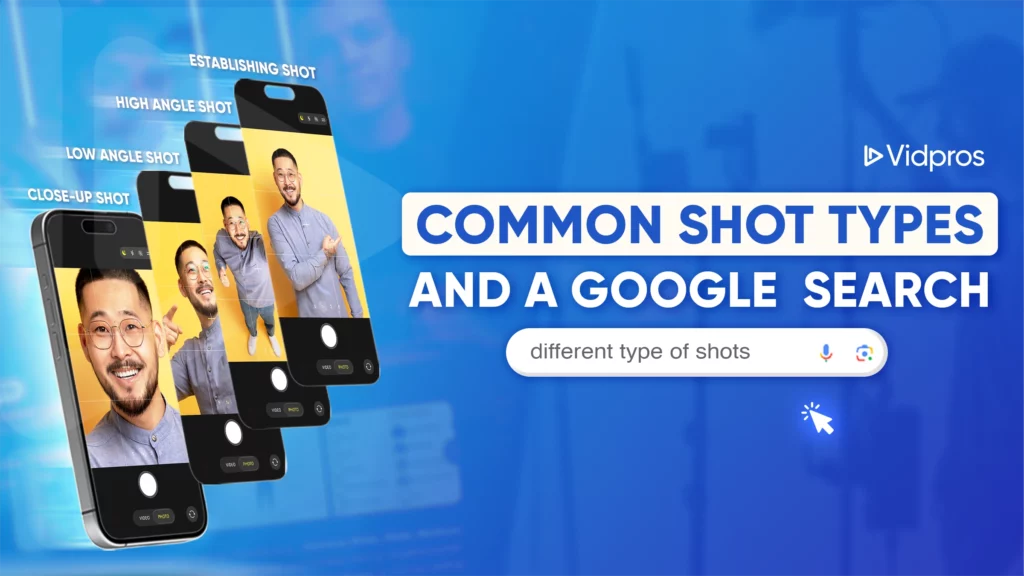
Real filmmakers, content creators, and storytellers constantly wrestle with why we/they use each common camera shot and what it actually does to the viewer’s brain. It’s about human attention.
Why certain shots actually perform better? Why the others don’t? And on platforms like TikTok, Instagram, YouTube, and even in podcasts with video, how you frame your subject can literally make or break engagement.
See also: What Camera Is Needed For YouTube Videos?
The psychology of common shot types (how shots manipulate attention)

When people search for common shot types, they usually want definitions. But we’re gonna talk about function and impact.
A. Why your brain loves close-up shot addiction
Everyone remembers the face. That’s not a coincidence.
A close-up shot dominates attention because humans (our brains, to be exact) are wired to read faces. This is usually an eye-level shot, particularly when showing emotions or creating intimacy but it can also be a shallow focus shot.
Our brains spend about 30%-40% of visual processing power on faces. That means when you cut to a close-up shot, you jump to the emotional center of the scene. But if the emotion isn’t earned in earlier beats, this shot type feels manipulative rather than expressive.
You must remember that in fast feeds, your first 1-2 seconds must answer:
-
- Who is this?
- What is happening?
- Why should I stay?
Even contemporary film scholars agree that close-ups can elicit affective responses in viewers when depicting faces and facial expressions. This is why popular creators often open with a close-up shot or medium shot right away, then cut to a wider establishing shot that reinforces context once the viewer is hooked.
It can also be a one-shot, but usually shorter takes, because long continuous close-ups can feel claustrophobic.
So, for example:
-
- A video that starts with a close-up shot of a facial expression gets more attention.
- And then a sudden pull back to an establishing shot gives the brain context after it’s curious.
That order often works better than the reverse!
B. Where most people screw up with close-up shots
- Too much headroom
- Too zoomed out
- Background distraction
- Camera movement that doesn’t add meaning
According to research, most viewers decide whether to continue watching within the first three seconds. So try to be cautious and purposeful when you choose among the common shot types of camera movement. It’s best if you complete it with voiceover or sound cues. And don’t rely on it for everything. Mix with medium shot and establishing shot contrasts.
Use close-up shots to:
-
- Reveal sincerity (face-to-camera movements and monologues, product reactions)
- Build empathy (testimonials, founder stories
- Anchor trust (more details which are mostly unfiltered as well as human imperfections)
How low angle shot and high angle shot dictate power dynamics

A low-angle shot makes characters look powerful: taller, more intimidating. Historically, dictators used low-angle propaganda to seem larger-than-life. (Go watch old rallies.) But, while in cinema, this is true, on social platforms, people mostly use this angle because their phone is lying on a table.
However, you can also use these (different) camera angles for moments where you need authority as well:
For example, for:
-
- Product reveals
- CEO intros
- Achievement moments
- Power transitions in narrative videos
How to make these camera shot angles work?
A great piece of advice is not to overdo it, as it can often make viewers feel the shot is/was “weird or unprofessional.”
Meanwhile, a high-angle shot shrinks people, making them (seem more) vulnerable. It is the emotional inverse of the low-angle.
In film, it’s used to evoke sympathy.
In content creation, it’s used to evoke relatability. And high-angle shots are often used to show a process (like cooking or drawing). But they only work when paired with context.
But, a high camera angle on its own? It will look like an accident.
So, camera angles matter emotionally, but only when viewers understand why they’re there. So, instead of thinking “low & high angles are cinematic,” think:
-
- What emotional signal am I sending?
- What doe camera shot angles show or hide?
- Is it helping the viewer understand the content in the first 3 seconds?
The establishing shot and the attention paradox
Wide camera angles of offices, cities, beaches, coffee shops. The classic cinematic opener. That’s the establishing shot.
It’s great, but it doesn’t always work. An establishing shot shows context: the where and when. That’s why it’s more valuable in long-form storytelling (think YouTube documentaries, ads, branded films). Casey Neistat is well known for using establishing shots, usually as an overhead aerial shot. But on TikTok or Instagram, viewers swipe within seconds…unless you manage to capture them with valuable content.
This means that in visual storytelling, for brands, establishing shots still matter, but only when used strategically. This angle often use deep focus shot. Because you want the audience to see the full environment clearly so as to understand context immediately.
This is why popular creators often open with a medium shot or even a close-up shot right away, then cut to a wider establishing shot that reinforces context once the viewer is hooked.
Best practices for establishing shot sets
-
- On vertical video, don’t start with a too wide shot: use a medium shot or closer.
- If you must show an environment in a vertical video, make it aesthetic. Like very aesthetic!
- In podcasts with video, start with a medium shot so the viewer sees your face, then cut to a wider context when needed.
- And above all, test your first 3 seconds.
The over-the-shoulder shot: intimacy, perspective, and viewer inclusion

The over-the-shoulder shot (or OTS) is everywhere: in movies, interviews, podcasts, and vlogs. So, it’s important to realize how powerful it is in content creation.
This is one of those camera shot types that makes viewers feel like participants, not spectators, and it creates the illusion of shared space. It can capture interactions between (two) characters within a single camera frame.
Meanwhile, in marketing, OTS shots are great for tutorials and/or testimonials. When the camera peers over someone’s shoulder while they do something (paint, cook, code, design) viewers mentally step into that role.
Basically, for brand storytelling, an OTS shot can humanize scale. So, instead of showing a drone shot of a factory, show a worker’s view walking inside. And, instead of a polished office, show a laptop screen from someone’s desk.
That’s also the kind of camera shot that turns abstract “brands” into lived experiences.
The point of view (POV) shot — immersion and empathy in the scroll age

POV is one of those common shot types that exploded with the rise of TikTok and GoPro culture.
From first-person travel videos to product unboxings, the POV shot lets viewers be the creator. Most articles gloss over POV as “camera sees what the character sees”. But we like to think of it as not that much about camera angles, than it’s about subjectivity.
Why it works? The brain’s mirror neurons activate when you see something as if in your eye line or through your own eyes to be exact. That’s why POV cleaning, cooking, and travel content feels addictive…simply because it simulates experience, and it helps you see more details.
It can also be a one-shot if the camera follows a single continuous perspective. And the brain adopts the perspective. That’s why even horror and action use POV. It triggers simulation, and simulation = empathy. Recent data shows that using first-person videos increases social engagement by 37%.
How to make POV work?
POV videos perform ridiculously well because they:
-
- Break the fourth wall (you’re talking to the audience, not at them).
- Create intimacy
- Hack retention (people rewatch to “get” the perspective)
If you’re filming POV content:
-
- Use a medium shot to keep the background context without losing connection.
- Keep the camera shot at eye level
- Reminder: A subtle low-angle shot can make the audience feel smaller or less dominant (great for roleplay or authority POVs).
- A slightly high-angle shot softens dominance.
Medium shot: the narrative workhorse

Most think a medium shot is “B-roll” or “default”. Wrong. The medium shot is the conversation engine.
The medium shot is a middle ground between personality and context. It shows the actor’s upper body, such as hands, posture, waist shot and some set. It’s typically eye-level, especially in social media or podcast setups. It’s the standard talking-head framing where the viewer feels like they’re on the same level as the speaker.
It’s considered neutral, and creators treat it like a safe default. That’s why a ton of YouTube, interviews, and corporate vids are just endless medium shots.
However, as already stated, such a static shot is great for talking heads. But if you add slight motion (think a slow push or pull), viewers stay engaged longer.
You might also like: Best Cameras for Talking Head Videos | Top Picks
On platforms where sound auto-plays muted first (like Instagram Reels), your visuals must communicate instantly. That’s where medium shots are best at because they show enough to understand intent.
When to use this shot? Use it for trust building.
So your video flow should often be:
- Quick medium shot intro
- Close-up hook within 2-3 seconds
- Medium shot context
- More detail close-ups
- Ending in a medium or establishing shot for closure
Capping off
You’re probably heard this before “Viewers don’t remember what you said, they remember how you made them feel.”
And the fastest way to shape that feeling is through camera position and shots.
So, if you take nothing else from this article, know this:
- Use close-up shots to win trust.
- Use medium shots to teach.
- Use establishing shots to breathe.
- Use low camera angles for confidence.
- Use high camera angles for humility.
- Use POV to let people live your story.
They are psychological tools that’s why understanding them (how they feel, how they work, and how to combine them) transforms your simple videos into true storytelling. Because your shot order matters more than each one alone.
Sometimes the ideas are great, but the video editing isn’t quite there yet. So, if editing isn’t your favorite part or you just don’t have the time, Vidpros can handle it for you. Booking a call is an easy way to see how to make your videos look and feel exactly how you imagined.