
If you want to understand 2026 YouTube stats, you have to look deeper than “2.5 billion users.”
Because while that number is huge, it hides trends most people miss: like who is watching, where are they watching from mostly, is mobile still the top device or not? If not which is?
We’ll look at the figures, interpret them, and give you context that actually matters for all creators.
YouTube statistics: How many people really use YouTube in 2026, and who they are
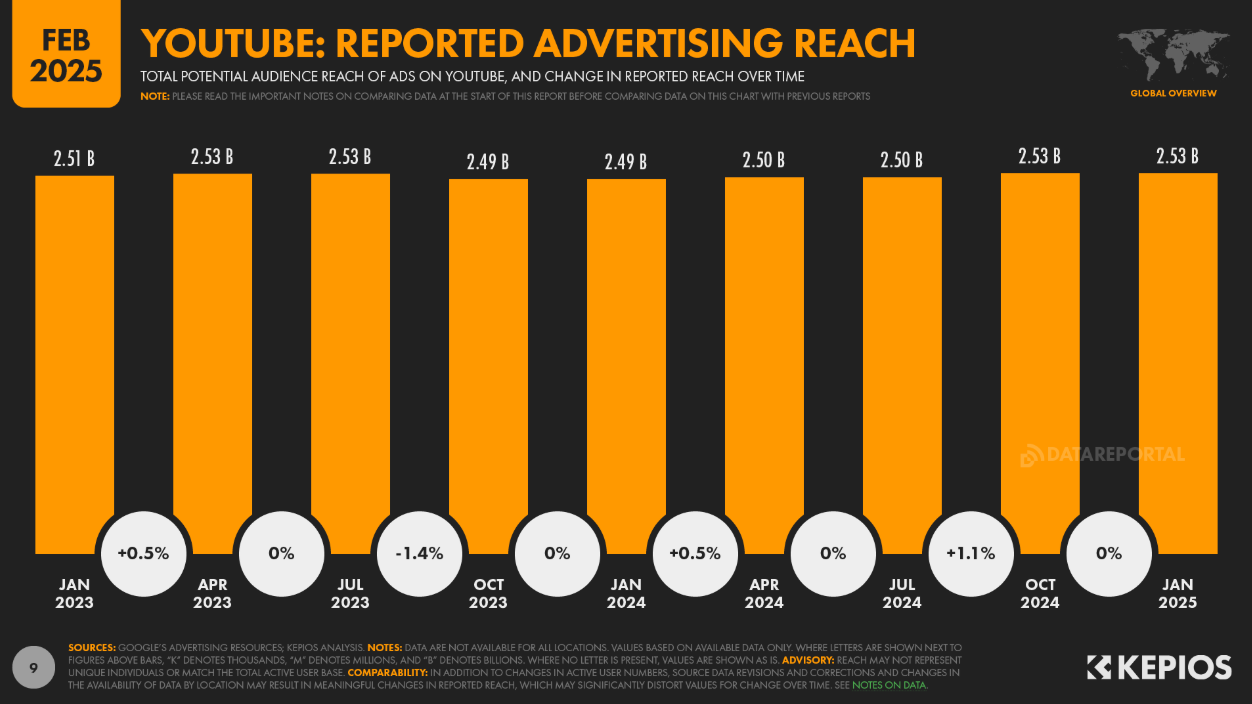
As already stated, YouTube has about 2.5 billion monthly active users worldwide, making it the most-used platform on the planet (outside of China, as measured by ad reach)!
In the U.S. alone, 254 million potential YouTube users are reachable via ads, reaching roughly 73% of the population.
There are 6+ billion internet users worldwide as of 2026, meaning YouTube now reaches almost half of all people online.
YouTube’s audience spans every age group and demographic
- About 60% of U.S. internet users visit YouTube daily.
- Emerging markets like India, Vietnam, Bangladesh, the UK, and Singapore are also showing rapid YouTube adoption, with tens of millions of localized users.
- In India alone, 491 million YouTube users are present as of late 2025, making it the largest single national YouTube market.
- India, the United States, Brazil, Mexico, Japan, Germany and Vietnam have the biggest audience sizes on YouTube.
That makes YouTube not just a “video app” , but a core part of online life. If internet users are the planet’s digital population, then a huge portion of them use YouTube monthly.
Source: Data Source
Mobile vs TV vs desktop – where people are actually watching
Almost every stat you read says mobile is king. And that’s true… unless you live in a market like the UK, where TV sets have become the most popular YouTube watch device.
Here’s what’s happening:
- Most users still watch via the YouTube mobile apps, especially younger demographics (which is the most common trend)
- But in mature markets, big screens (TVs) are dominating for longer YouTube watch sessions.
- That’s especially true for kids and family content.
So, basically, YouTube isn’t just a “phone thing” anymore, but in some countries it’s become a living room medium or thing too.
It’s not just teens anymore
While younger generations flocked to YouTube years ago, the platform is aging with its audience:
- Adults 25-34 still make up a chunk of users (some data suggests).
- But according to Datareportal, the average age of YouTube users is 35-44 years old.
- The data also suggests that male users aged 25-34 accounted for the greatest share of active YouTube users.
- Older groups (including 55+ year olds) watch YouTube more than ever, especially on TV.
- More older users are watching longer content (news, DIY, podcasts, documentaries), which changes creator strategy outright.
YouTube statistics: How content consumption works on YouTube in 2026
Video length preferences
One of the biggest changes in 2026 YouTube stats is that video length isn’t an either/or debate. Short-form AND long-form coexist in distinct roles, and both have measurable effects on consumption behavior.
Short-form content has exploded in views.
Some analytics show that YouTube videos under a minute (Shorts) accounted for as much as 75-77% of global views in 2025, a figure that likely continues into 2026.
This dominance isn’t just because Shorts are …umm…short, but also because the format is optimized for quick gratification and continual discovery. Each short is designed to grab attention in the first few seconds and keep people swiping, generating massive immediate view counts.
But, of course, while short videos generate huge numbers, their watch time per video is tiny compared to long-form content. Longer YouTube videos (5-20 minutes or more) still drive a huge watch time spent on the platform.
This is especially true when talking about topics like learning, deep stories, interviews, reviews, or documentaries, which is all content people intentionally seek out.
This creates an interesting pattern: short videos dominate views and feed algorithms, while long videos dominate watch time, which remains one of the strongest signals YouTube uses (since 2012) to determine content quality and future recommendations.
So in 2026, creators and brands need two different consumption mindsets:
- Create Shorts to hook users and build audience volume.
- Create long-form YouTube videos to hold that audience and make more money in the process.
Attention spans aren’t shrinking…they’re contextual
Another deep insight behind 2026 YouTube stats is that attention span isn’t just “shorter” or “longer” . Better yet, it’s contextual depending on the viewer’s intent and content type. The idea that people watch short videos because they have shorter attention spans is incomplete.
Data from ad-planning tools and usage research show that average session lengths (especially on YouTube’s Android app) hover around 14-15 minutes per session, which is significantly longer than many other platforms.
That (once again) means people don’t just swipe shorts the whole time. They spend some good time watching various types of YouTube videos, from tutorials and reviews to vlogs and entertainment.
At the same time, watch patterns vary by device. For example:
- On mobile, viewers watch a mix of shorts and mid-length content during breaks or between tasks.
- On smart TVs and desktop devices, viewers watch longer videos or even full episodes and movies (especially in households and family settings)
So, consumption intent matters as much as video length.
Watching shorts for quick entertainment is ONE user behavior.
And watching deep(er) content for 20 minutes is another.
Algorithm behavior
While we don’t have direct internal YouTube data, public analyses of how the algorithm works suggest that YouTube doesn’t simply serve what’s most popular worldwide.
In a way, it serves what’s most likely to match each user’s behavior.
For example:
- If you’re watching short-form news clips in the early morning, YouTube will adjust its recommendations based on device and time of day, as well as your YouTube video history.
- If you’re watching a bunch of quick entertainment clips, the algorithm will continue to recommend more short content, not because YouTube ‘loves shorts,’ but because that’s what you’ve watched and engaged with in the past.
- If you’re watching a long documentary, YouTube will recommend more long content, encouraging more session time and engagement.
This logic behind the recommendations explains the self-reinforcing pattern of consumption. This means, e.g., repeat views, audience retention, session continuation, and “not interested” are influencing the next recommendations.
How watch behavior shapes creator strategies
People don’t just passively watch YouTube videos. They seek, pause, replay, and share.
YouTube is the default educational tool, entertainment source, and discovery engine for millions every day…especially outside traditional media markets.
That means creators can’t just hope for views.
They need:
- strong thumbnails,
- narrative hooks in the first 3 seconds,
- tailor content for mobile attention spans.
How creators should interpret these 2026 YouTube stats
YouTube statistics about reach
Yes, YouTube users in 2026 are counted in the billions. But that doesn’t mean everyone watches everything.
Audience behavior varies widely by:
- Geography (India vs Europe vs North America)
- Age (kids vs adults vs seniors) in different regions
- Device (phones vs TVs vs desktops)

Source: Dataportal
Advertising revenue and monetization potential of YouTube channels
YouTube’s business model is expanding.
- In 2025, YouTube generated over $11.38 billion in revenue from ads and subscriptions combined (which to be honest is more than many legacy TV networks.)
- YouTube Premium and other services are adding paid loyalty on top of ads.
- YouTube Premium and YouTube Music together have more than 100 million subscribers around the world.
- YouTube’s global potential audience reach figure increased by 1.6% in the 12 months in 2025.
- Marketers were able to reach nearly 40 million more users with YouTube ads in 2025 than one year prior.
- YouTube total watch time is a key monetization metric, often requiring 3,000- 4,000 public hours of video within a year to qualify for program benefits.
- Even though it has to be said that YouTube’s ad reach is slower than that of other social media platforms like TikTok or Instagram in the same period, according to Datareportal.
- If you can structure topics so they appeal strongly in top‑CPM countries (US, Canada, Western Europe, Australia), your RPM jumps even with the same view count.
- According to Social Blade there are around 87 million YouTube creators. Talk about platform’s popularity.
- MrBeast is the top-ranked YouTuber in the US for entertainment content and the most subscribed YouTube channel. His YouTube channels revenue can reach up to $156M per year according to Social Blade.
- You earn a cut of the ad spend that runs on your YouTube videos; RPM is your real revenue per 1,000 views after YouTube’s share.
- You also earn from YouTube Premium subscribers based on their average watch time on your content.
See also: YouTube Shorts monetization in 2026: How much money you can make
Capping off
If you zoom out, the story behind these 2026 YouTube stats and YouTube video monetization isn’t about how many views or internet users the platform has, it’s about how YouTube has quietly become the backbone of the internet.
It’s not a “social media site” anymore, it’s the world’s biggest stage.
But with billions of users and millions of uploads every minute, visibility is no longer about luck.
The creators and brands winning today are the ones who’ve turned content production into a system.
So, not in chasing the algorithm, but in mastering your process. And if you can take editing off your plate, you can spend that time doing the researching, writing, or connecting with your viewers.
So if you’re ready to keep up with how fast YouTube moves in 2026, start thinking like a producer, not a poster.
And if you want a hand making your content look sharp (without losing your sanity) check out Vidpros. Our $100 trial gets you one long-form or ten short-form edits (a week’s worth of content), so you can focus on creating while someone else handles the other processes.

Because on YouTube today, attention isn’t always the hardest thing to get. Keeping it is.