
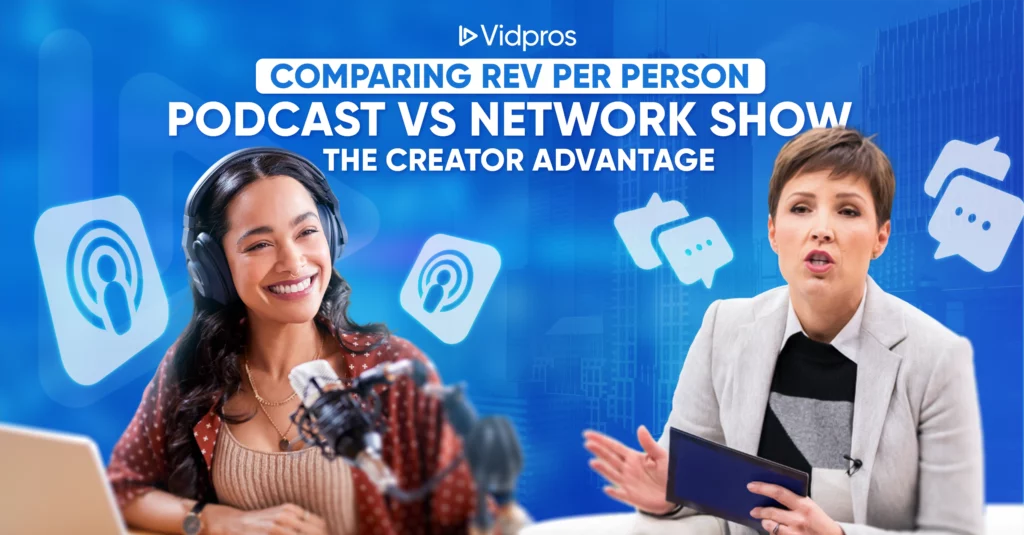
Big media companies are struggling while small creators are winning. Here’s what’s happening and why it matters.
CBS just ended “The Late Show with Stephen Colbert” and will retire the “The Late Show” franchise in May 2026. Even though it was the highest-rated late-night broadcast, the show reportedly lost $40 million yearly for CBS.
Traditional TV shows need huge teams and expensive studios. They have writers, producers, camera crews, editors, and marketing teams. All these people cost money.
While big TV shows get cancelled, small podcast creators are making millions with just 2-3 people. Popular successful podcasts, such as Joe Rogan’s show, generate massive revenue with small teams compared to traditional TV.
Podcasting is booming. Podcast advertising revenue in the United States reached over 1.8 billion U.S. dollars in 2022, and US podcast revenue is expected to hit $2.4 billion this year.
Key differences: Creator vs traditional media revenue
Traditional TV: Around $300,000 in revenue per employee
Digital creators: Up to $1.5 million per person
This gap exists because digital creators don’t need expensive studios, large crews, or complex distribution deals. They can create content from home and reach millions of people directly through the internet.
The shocking Math behind the media’s transformation

Traditional TV: The $40 million money pit
Late-night TV shows are losing massive amounts of money. Colbert’s show alone loses about $40 million each year because fewer people watch and advertisers pay less.
Since 2018, late-night TV ad revenue has dropped by half as podcast listeners and viewers move to streaming and digital platforms. Colbert’s show generates around $60 million but incurs $100 million in expenses, including star salaries and production costs.
The numbers tell the story: Colbert’s ad revenue fell from $121 million in 2018 to $70 million in 2024—a 42% drop. His show averages 2.2 to 2.5 million viewers, but only 10% are in the 18-54 age group that advertisers want as their target audience. Many viewers now watch clips on YouTube instead, where ads generate significantly less revenue than traditional TV.
Creator Economy: Lean machine success
The Pivot Podcast is a lean and highly profitable creator economy success story, producing quality podcast episodes consistently, with about 15 team members generating roughly $25 million in revenue. This translates to a revenue per employee of approximately $1.67 million, which is about five times higher than traditional TV shows like Stephen Colbert’s Late Show.
The Pivot Podcast is growing at an estimated 20% annually, significantly outpacing traditional media, which is experiencing declines or stagnation.
For content creators, this shift means:
Lower overhead leads to higher profit margins. Unlike traditional media, which often relies on large teams and costly productions, creators can operate with lean setups, dramatically reducing costs.
Direct audience relationships create sustainable revenue. Creators building direct connections with their audiences establish revenue streams less reliant on volatile ad markets.
Technology acts as an equalizer. Modern digital tools democratize access to content creation and distribution.
Why traditional media is bleeding money

The infrastructure trap
Traditional media faces what we can call the “infrastructure trap”:
Million-dollar studios vs. home setups. Traditional TV and internet radio station productions operate from expensive studios with high fixed costs tied to real estate, equipment, and maintenance. In contrast, creators typically operate from low-cost home studios or small offices.
200-person crews vs. creator + editor teams. Large TV productions involve big teams including on-screen talent, writers, camera crews, technical support, and administrative staff—often numbering hundreds. Creators usually function with much smaller teams, frequently just themselves plus a few collaborators like editors.
Union contracts vs. flexible freelancer networks. Traditional media relies on unionized labor agreements and long-term contracts, which contribute to high fixed personnel costs and limited operational flexibility. Many creators utilize freelance networks or contractors with flexible, project-based agreements.
Distribution disadvantages
Traditional media faces key distribution disadvantages:
Broadcast schedules vs. on-demand consumption. Traditional internet radio broadcasting and TV rely on linear broadcast schedules, requiring viewers to watch shows at preset times. This limits convenience and clashes with modern viewer habits that favor on-demand access.
Single platform dependency vs. multi-platform strategy. It often depends heavily on a single platform or network. Creators use multiple platforms (YouTube, TikTok, podcasts, social media) to diversify reach and revenue sources.
Inability to monetize viral moments effectively. Traditional TV struggles to capitalize on viral or trending content due to rigid schedules and slower production cycles. Creators can immediately respond to viral moments with new content and monetization opportunities.
The demographic dead end
Traditional media faces a significant demographic problem:
Aging audiences with declining purchasing power. Traditional TV predominantly attracts older viewers (50+), whose spending power is often lower compared to younger demographics.
Advertiser exodus from traditional formats. Advertisers increasingly shift budgets away from traditional media to digital channels that better target younger, high-value demographics.
Content that doesn’t travel across platforms. Traditional media content is often designed for linear TV broadcast, limiting its adaptability across emerging digital and social platforms.
The creator advantage: Why small teams win

The creator advantage is enabled mainly by technology:
Professional-quality content from basic equipment. Advances in camera, audio, and lighting technology now allow creators to produce high-quality video podcasts and content with relatively affordable gear.
Cloud-based workflows eliminate geographic barriers. Cloud production and editing platforms enable creators and collaborators to work seamlessly from anywhere in the world with just an internet connection. This removes the need for centralized studios and expensive physical infrastructure.
AI tools reduce post-production costs and time. AI-driven editing helps automate repetitive tasks, such as color correction, sound leveling, and footage selection. This significantly shortens post-production timelines and lowers costs.
What’s particularly interesting is how professional video editing services like Vidpros have become a key part of this equation. Many successful creators have discovered that outsourcing their editing allows them to focus on content strategy and audience engagement while maintaining professional quality. This approach enables them to scale their output without hiring full-time employees, maintaining lean operations while competing with traditional media standards.
Multiple podcast platform revenue streams
Content creators in 2025 have multiple robust podcast monetization and revenue streams:
Sponsorships and brand partnerships. Many creators earn thousands per campaign by collaborating with brands that align with their niche audiences.
Subscription/membership models. Platforms like Patreon and YouTube Memberships allow creators to monetize loyal fans through monthly subscriptions.
Merchandise and product sales: Selling branded merchandise directly to fans deepens fan connection while driving sales
Course creation and coaching. Expertise-driven creators monetize knowledge by offering online courses and workshops.
Live events and speaking engagements. Many creators supplement income through live shows and paid speaking gigs.
Platform monetization. Ad revenue, tipping, and other platform monetization features on Apple Podcasts and similar platforms enable creators to earn directly from their content.
These diverse revenue streams enable creators to maximize their earning potential while reducing their reliance on any single income source, contrasting with traditional media’s dependency on advertising.
Direct audience relationships
Direct audience relationships offer creators significant advantages:
No network intermediaries taking cuts. Creators monetize directly from their audiences, retaining a larger share of revenue without needing to share profits with networks or distributors.
Real-time feedback and content optimization. Direct engagement with audiences via comments, polls, and social media allows creators to receive immediate feedback and adapt content quickly.
Community building drives long-term value. Authentic interaction builds strong, loyal audience communities, resulting in higher retention and recurring revenue.
Email lists and owned audiences. Creators build owned assets like email lists and private communities that provide stable direct communication channels.
Platform Success Stories

YouTube: The new television
YouTube has emerged as the new television, reshaping how content is created and monetized:
MrBeast’s operation. MrBeast leads as YouTube’s top earner, with an estimated annual revenue of around $54 million. His success is powered by a lean, highly efficient team that produces massive-scale, engaging content.
Educational creators outearn university professors. Many education-focused creators now generate substantial income through courses, sponsorships, and membership models, often surpassing traditional academic salaries.
Gaming creators vs. traditional sports broadcasting. Gaming content creators have built massive global followings, sometimes rivaling or exceeding viewership of conventional sports broadcasts.
TikTok: Micro-content, macro-revenue
TikTok has become a powerhouse for micro-content creators generating macro-revenue:
Individual creators matching network show revenues. Top TikTok creators can earn millions annually, with some individual stars rivaling or surpassing income from traditional TV network shows.
Lower production costs, higher engagement rates. TikTok’s short-form video format requires less expensive production equipment and time compared to traditional TV, enabling creators to produce content quickly and consistently.
Brand partnership rates are competing with traditional advertising. Brands are increasingly prioritizing TikTok for their advertising dollars, with partnership rates and ROI that are competitive with or better than those of legacy media.
TikTok’s global ad revenue exceeded $23.6 billion in 2024 and is projected to hit $33.1 billion in 2025, with millions of creators benefiting from the platform’s monetization programs.
Podcast Advertising: The intimacy advantage
Podcasting offers creators a unique intimacy advantage:
Joe Rogan’s $200M+ Spotify deal. Rogan’s multi-year Spotify contract is now valued at up to $250 million, reflecting his top-ranking podcast status and immense audience reach.
Independent podcasters building sustainable businesses. Many independent podcasters generate steady, growing income through podcast advertising networks, sponsorships, post-roll ads, dynamic ad insertions, and listener support models.
Advertising rates and audience loyalty. Podcast ads command premium advertising rates, benefiting from deep listeners’ engagement and trust with the podcast host.
What traditional media gets wrong (and creators get right)

Content creation philosophy
Traditional media often gets key aspects of content creation wrong that creators get right:
Quantity + consistency vs. perfectionist paralysis. Traditional media tends to focus on highly polished, infrequent releases. Creators prioritize consistent, frequent output, understanding that steady engagement outweighs perfectionism.
Audience feedback integration vs. focus group dependency. Creators engage directly with audiences through comments and social media. Traditional media relies more on slow, costly focus groups and executive decisions.
Rapid iteration vs. committee-driven development. Creator content evolves rapidly based on immediate data and feedback. Traditional media often operate through hierarchical committees with lengthy review cycles.
Business model innovation
Creators today succeed by innovating business models that diverge from traditional advertising-dependent media:
Diversified revenue vs. advertising dependency. Creators blend multiple income streams to reduce risk and build long-term financial stability. This contrasts with traditional media’s heavy reliance on fluctuating ad budgets.
Direct creator-audience transactions. Creators use direct fan payments through memberships, crowdfunding, and exclusive content sales.
Community monetization strategies. Building an engaged community enables creators to monetize through tiered memberships, live events, and exclusive access.
Technology adoption
Successful creators embrace:
Early platform adoption vs. late follower strategies: Successful creators quickly adopt emerging platforms to access new audiences and untapped content formats.
Tool utilization for efficiency vs. legacy system constraints. Creators leverage modern digital tools, AI-driven editing, automation, and cloud-based workflows that boost productivity.
Data-driven decision making vs. traditional intuition. Creators use real-time analytics and audience feedback to optimize content and monetization models.
This is where brilliant creators are making strategic investments. Rather than trying to master every aspect of production themselves, they’re identifying which tasks provide the highest return on their time investment. Many have found that while they excel at content creation and audience engagement, partnering with professional services for time-intensive tasks, such as editing, allows them to scale more effectively.
What’s Next: Work smarter, not harder
Understanding this shift is essential because:
Career opportunities. More jobs are moving to digital creator companies.
Investment trends. Money is flowing away from traditional media to creator platforms.
Content consumption. Younger audiences prefer podcasts (median age 34) over network TV (median age 57).
Media is changing fast. Companies that can do more with fewer people are winning, while old-fashioned media companies are losing money and shutting down shows.
The gap between $1.5 million per person (creators) and $300,000 per person (traditional TV) will likely continue widening. Traditional media must adapt quickly or risk becoming obsolete. For creators, this represents an unprecedented opportunity to build sustainable, profitable businesses by embracing lean operations, building direct audience relationships, and adopting innovative technology.
The future belongs to those who can create more value with fewer resources. In this new economy, efficiency isn’t just an advantage—it’s survival.
Capping off
CBS canceled Colbert’s show even though it was number one. Why? It lost $40 million a year. Meanwhile, small creators make millions with tiny teams.
Big media companies are stuck with expensive studios and huge staff. Brilliant creators work lean and focus on what matters most—their audience. The best creators don’t do everything themselves. They create content and build their audience while pros handle the rest.
Want to work smarter? Let Vidpros edit your videos so you can focus on creating and connecting with viewers. Book a call with Vidpros to see how professional editing helps you compete without the big budgets.