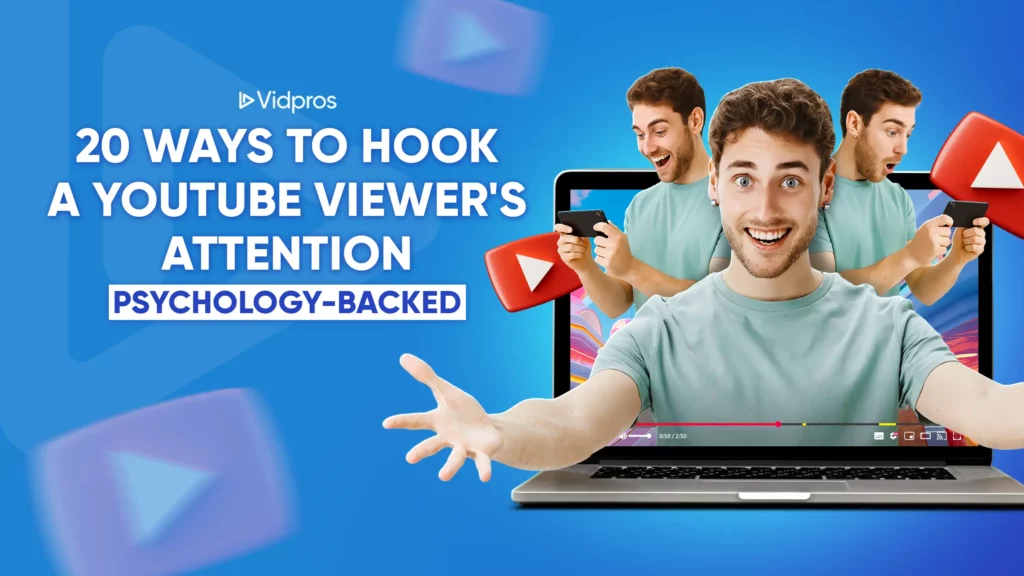
What separates the videos you can’t stop watching from the ones you skip after three seconds? It’s not what you think.
Last week, I found myself watching 20 videos in a row about making sourdough bread. I don’t even like bread that much. I don’t have time to make my own. Yet there I was, at midnight, completely hooked by a video called “Why Your Sourdough Keeps Failing (It’s Not What You Think).”
Sound familiar? We’ve all been there. But here’s what’s fascinating: it wasn’t the topic that hooked me. It was something much more basic.
The 8-second survival instinct (when viewers drop off)
Your brain makes viewing decisions faster than you can consciously think. In those crucial first moments, your prehistoric wiring is asking one simple question: “Is this worth my survival energy?”
Most creators get this backwards.
They think hooks are about being clever or creative. But the most successful YouTubers understand something deeper: hooks aren’t about getting attention, they’re about hijacking attention.
While other guides give you 15 basic techniques, I’m going to show you 20 psychological triggers that work. These aren’t just tips; they’re based on real brain science.
The brain science behind how to hook viewers with irresistible content
Your brain has an obsessive need to complete incomplete information. It’s called the Zeigarnik Effect, and unfinished tasks create a cognitive burden, weigh more heavily on the mind, and are more easily recalled than completed tasks.
Your brain can’t ignore questions. When someone asks you something, your mind automatically starts looking for the answer. Scientists call this “instinctive elaboration” – it means questions grab your attention without you even trying.
TL;DR

Now, let me show you all 20 hooks that tap into these psychological triggers:
1. The Cliffhanger Drop
Start right in the middle of the most exciting part of your story. “I had 30 seconds before the building exploded…” Then loop back to explain how you got there.
People tend to remember unfinished or interrupted tasks more effectively than completed ones. Your brain needs closure. This is the Zeigarnik Effect in action.
Think about the most dramatic or surprising moment in your video. Start there, then say “But let me back up and explain how I got here.” This works great for adventure videos, business stories, or any content with a journey.
Make sure the payoff matches the setup. Don’t promise explosion-level drama if your story is about learning to cook pasta.
2. The Contradiction Hook
Say something that sounds impossible. “This 12-year-old makes more money than most doctors,” or “The world’s strongest man can’t open a pickle jar.”
Your brain needs to resolve contradictions. It sticks around for the explanation. This triggers cognitive dissonance – the mental discomfort we feel when holding conflicting beliefs.
Look for surprising contrasts in your topic. What seems backwards or impossible? What defies common logic? The contradiction must be real and proven. False contradictions will make viewers feel tricked and leave angry comments.
3. The Question Hijack
Ask something your viewer can’t ignore. “What if I told you that brushing your teeth is making them weaker?”
Your brain can only focus on one thing at a time. When it’s working on a question, everything else gets blocked out. Scientists call this instinctive elaboration – it means questions take over your thinking.
Start with “What if I told you…” or “What would you do if…” Follow with something that challenges their assumptions about everyday things. The question should be about something they care about personally. Generic questions get generic attention.
4. The Fear Factor
Touch on something your audience is afraid of losing or missing. “Most people don’t realize they’re destroying their future with this one habit.”
Fear of loss is stronger than desire for gain. It triggers immediate attention because of loss aversion – our psychological tendency to prefer avoiding losses over acquiring gains.
Think about what your audience values most (time, money, relationships, health). Then highlight a threat to that thing they might not know about. Don’t use fake fear. Real concerns work better and build more trust than manufactured panic.
5. The Secret Reveal
Promise insider knowledge. “I’m about to show you the method that got me 1 million subscribers that nobody talks about.”
Humans are naturally curious about hidden information. We want to be “in the know.” This taps into information gap theory – the idea that curiosity arises when we perceive a gap between what we know and what we want to know.
Share something you learned behind the scenes, from expensive courses, or through personal experience that isn’t common knowledge. The secret must be valuable and somewhat unknown. Don’t call obvious advice a “secret.”
6. The Time Crunch
Create urgency around information. “You have until age 25 to do this, or your brain stops being able to…”
Scarcity creates immediate action. People pay attention when there’s a deadline. This works because of the scarcity principle – we value things more when they’re limited or time-sensitive.
Find natural deadlines or time-sensitive opportunities related to your topic. Age limits, seasonal changes, or limited-time opportunities work well. The urgency should be genuine and based on facts, not artificial pressure you created.
7. The Personal Stakes
Share what you had to risk or lose. “I spent my last $500 on this experiment, and here’s what happened…”
Personal stakes make viewers emotionally invested in your outcome. This creates emotional investment – when people care about what happens to you, they stick around to see the result.
Talk about real risks you took – money, time, reputation, relationships. Be specific about what you put on the line. Only share stakes that are proportional to your situation. Don’t exaggerate for drama.
8. The Myth Buster
Challenge something everyone believes. “Everything you learned about saving money is wrong, and here’s proof.”
People are naturally drawn to information that challenges their existing beliefs. This works against confirmation bias – our tendency to search for information that confirms our preexisting beliefs.
Find commonly accepted advice in your field that’s outdated, incomplete, or wrong. Provide evidence for why the popular belief doesn’t work. Have strong evidence to back up your claims. Contrarian views need extra proof.
9. The Social Proof Bomb
Use numbers that seem impossible. “This video has been shared 2 million times, but most people miss the real message.”
We pay attention to what other humans find interesting. Big numbers signal importance. This leverages social proof – our tendency to look to others for cues about how to behave.
Share impressive metrics about your content, results, or research. Then promise to reveal something others missed. Use real numbers you can verify. Fake metrics are easy to spot and destroy credibility.
10. The Curiosity Gap
Create a space between what they know and what they want to know. “The one thing every successful person does before 6 AM.”
Knowledge gaps create psychological tension. Your brain wants to close them. This is based on curiosity research showing that curiosity is triggered when we detect information gaps.
Promise specific, actionable information that solves a problem they have. Be precise about what you’ll reveal. Make sure the gap is the right size – big enough to matter, small enough to seem achievable.
11. The Pattern Break
Do something unexpected right away. Start with silence, speak in a different language, or film upside down.
Your brain runs on autopilot. When something breaks the pattern, attention goes into overdrive. This works because of pattern recognition – our brain’s tendency to predict what comes next.
Think about what viewers expect from your type of content. Then do the opposite for the first few seconds. Then do the opposite for the first few seconds—start with a joke when they expect seriousness, or be serious when they expect humor. The pattern break should connect to your content in a meaningful way. Random weirdness just confuses people.
12. The Emotional Mirror
Reflect exactly how your viewer feels. “If you’re tired of working hard but getting nowhere, this is for you.”
People pay attention when they feel understood. Mirror neurons fire when we see ourselves reflected in others, creating instant connection and empathy.
Describe the exact frustration, desire, or situation your ideal viewer is experiencing. Use their words and emotions. Research how your audience talks about their problems. Use their language, not yours.
13. The Authority Borrow
Quote someone famous or credible. “As Einstein once said, ‘Compound interest is the eighth wonder of the world,’ but here’s what he didn’t tell you…”
We transfer trust from credible sources to the person quoting them. This uses the authority principle – our tendency to follow the lead of credible experts.
Find quotes from respected figures that relate to your topic. Then add your insight or twist to the quote. Use real quotes you can verify with quote verification tools. Misattributed quotes make you look careless.
14. The Future Flashback
Show them what life could look like. “Imagine waking up tomorrow and never worrying about money again.”
The brain can’t tell the difference between imagined and authentic experiences. Visualization creates emotional investment through mental imagery – our ability to experience sensory information without direct sensory input.
Paint a vivid picture of their ideal future state. Make it specific and sensory – what they’ll see, feel, and experience. Make the future vision specific and believable. Vague promises don’t motivate action.
15. The Mistake Confession
Admit to a costly error. “I wasted three years doing this completely wrong…”
Vulnerability builds trust, and people want to avoid making the same mistakes. Research on vulnerability shows that admitting mistakes increases credibility and trustworthiness.
Share an honest mistake that cost you time, money, or opportunity. Explain what you learned from it. The mistake should be relatable to your audience’s situation. Your failure should help them succeed.
16. The Trend Hijack
Connect your content to something happening right now. “While everyone’s talking about AI taking jobs, here’s the skill that makes you irreplaceable.”
Current events already have attention. You’re borrowing that attention for your message through attention transfer – redirecting existing focus to your topic.
Look at trending topics in news, social media, or your industry using Google Trends. Find a way to connect your message to what people are already discussing. Connect naturally to the trend. Forced connections feel desperate and turn people off.
17. The Number Shock
Use a statistic that surprises. “95% of people who try this quit within 48 hours. Here’s how to be in the 5%.”
Surprising numbers create cognitive dissonance. People need to understand why the number is so extreme. This works because of statistical surprise research showing that unexpected data captures attention.
Find research or data that reveals something unexpected about your topic using statistical databases. The number should be surprising but believable. Have a source ready if people question your statistic. Surprising numbers get fact-checked.
18. The Identity Challenge
Question who they think they are. “If you think you’re not creative, you’re probably the most creative person you know.”
Identity is core to how we see ourselves. Challenges to identity demand attention because of identity theory – how we define ourselves affects our behavior and attention.
Challenge a limiting belief your audience has about themselves. They might be more capable than they think. Be encouraging, not accusatory. You want to expand their identity, not attack it.
19. The Behind-the-Scenes
Show something usually hidden. “Here’s what happens when the camera stops rolling…”
People are naturally curious about what goes on behind the curtain. This taps into introductory curiosity psychology – our drive to understand how things work.
Share the process, failures, or reality behind something that looks polished from the outside. Make sure your behind-the-scenes content is interesting or valuable, not just filler.
20. The Meta Hook
Acknowledge what you’re doing. “I know you’re probably going to click away in the next few seconds, but what I’m about to show you is the reason I dropped out of medical school…”
Breaking the fourth wall feels honest in a world of manufactured content. It’s reverse psychology at its finest, working through meta-cognition – thinking about thinking.
Acknowledge the viewer’s situation, your agenda, or the nature of online content. Then explain why this time is different. Only use this when you genuinely have something different to offer. Don’t acknowledge clickbait if you’re using clickbait.
The three-part hook formula
The best hooks don’t just grab attention, they set up everything that follows. Here’s the simple formula:
- Grab (get their attention in 3 seconds)
- Gap (create curiosity about what’s coming)
- Guide (show them where you’re taking them)
Example: “I just lost $10,000 in 24 hours [GRAB]. But this failure taught me something that’s already made me $50,000 [GAP]. And I’m going to show you exactly how to use this same lesson [GUIDE].”
Why most creators get this wrong
They focus on the hook rather than the reason someone needs to hear what follows. Many industry experts make this same mistake, they treat viewers like an audience instead of individuals with real problems. They prioritize views over value.
The best hooks aren’t tricks, they’re promises. And the creators who understand this don’t just get more views. They build audiences who genuinely care about what they have to say.
Capping off
That sourdough video? It hooked me because the creator understood I wasn’t interested in bread. I was interested in understanding why things fail and how to fix them. The sourdough was just the vehicle.
What’s the real story your content is telling? That’s your hook.
But here’s something most creators miss: your hook only works if your editing supports it. The first 15 seconds need quick cuts, engaging visuals, and perfect audio. A great hook with slow editing or bad audio will still lose viewers.
The most successful YouTubers spend 80% of their time on the first 15 seconds of their videos, understanding that each platform rewards creators who master this crucial window. They know that everything else—their message, their business, their impact—depends on those crucial opening moments.
If you’re spending hours editing when you could be creating more content, that’s time stolen from crafting better hooks. Professional editors like Vidpros specialize in making content creators look and sound amazing without the editing headache, so you can focus on what matters most: creating hooks that hijack attention.
Now you know the psychology behind irresistible content. More importantly, you know how to use it.
Ready to turn your hooks into professional-quality videos that convert viewers into subscribers? Book a call with Vidpros and let our team handle the editing while you focus on creating content that hooks, holds, and converts.