
If you’ve searched new true crime podcasts lately, you’ve probably had the same experience I have.
You open your podcast app. You scroll. You see the same “best of all time” recommendations. Then you realize half the list is from years ago.
And look, those shows can still be great. But that’s not what you typed.
You’re here for new true crime podcasts, meaning recent releases, new seasons, or limited series with new episodes that people are actively talking about right now.
This list is built for that intent.
It’s also built for real life. Because sometimes you want a serious, deep dive with reporting. Sometimes you just want a true story that gets you absolutely hooked while you’re doing laundry.
One quick note for creators and marketing teams: true crime storytelling is basically a free lesson in pacing and hooks. If you’re repurposing podcast-style content into short clips, it’s a lot easier when editing is consistent. That’s the exact lane Vidpros helps with. Check it out.
Now let’s get you something new to listen to.
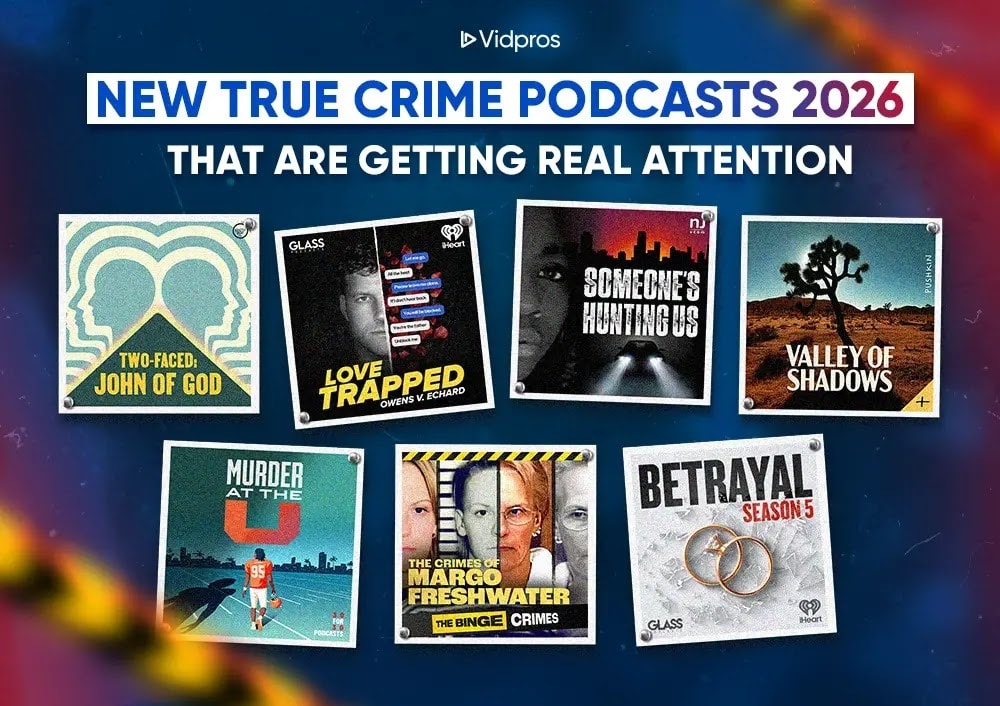
New True Crime Podcasts 2026 That are Getting Real Attention
2026 is going to bring in a lot of new stuff, as most New Year’s do.
New shows. New seasons. New obsessions.
And honestly, if you’re a long-time podcast listener, true crime stories are always at the top of the list because they resonate well and are real. You don’t need a screen. You can listen while cooking, in the car, at home, or going for a walk, and you end up three episodes deep.
There is something about the format that works. This year, all we will have is more of the same; more of the ‘limited series’ style of true crime pods that create 6-10 episodic series that you can binge over a weekend.
Good for you, you don’t have to do the scrolling, we have the list for that.
I’ll keep this simple. No need for a full book report.
Two-Faced: John of God
If you like big investigations that feel larger than one town and one headline, start here.
This is a limited new true crime podcast series that leans investigative, with a clear structure and steady momentum. It’s the kind of show where the events leading to the bigger story are just as interesting as the big reveal.
If you want a nice turning point when everything comes together, check out Episode 4, “Breaking the Silence.” This one has the reporters for the biggest news company in Brazil looking into a Facebook post about John of God being accused of rape, and they realize, it’s not just one accusation. They spot more women with the same story, and you can see the series widen from “one scandal” to a hell of a lot more.
Best for: people who like serious reporting, not a loose chat format.
My take: I like how it builds. It doesn’t rush to shock you. It earns your attention.
Love Trapped
This one is modern and messy in the way modern life can be messy.
Right now, the best “episode” to tease is the trailer, because it sets up the whole storyline in about three minutes and shows you exactly why this became a full-on internet rabbit hole.
It’s an investigative series built around deception, money, and the kind of rabbit hole that starts with “wait, what happened?” and ends with a timeline you want to screenshot.
Best for: listeners who like scams, digital trails, and stories where the investigation feels current.
My take: this is the type of show that makes you pause and text a friend, “You have to listen to this.” That’s usually a good sign.
Someone’s Hunting Us
This is heavier subject matter, so pick your moment.
But it’s also the kind of reporting-focused true crime that highlights patterns people ignored for too long. It’s grounded, it’s purposeful, and it doesn’t treat victims like props.
If you’re the type to determine whether a series is worth your time and the answer has to be this episode, you can start with Episode 1, “The Missing Girls.”
Best for: listeners who want the story told with care, and who don’t want the tone to feel jokey.
My take: this one sticks with you. Not because it’s sensational, but because it’s real life.
Valley of Shadows
If your favorite crime podcasts are the ones that feel like journalism, this is a strong pick.
It has that slow-burn “something is off here” vibe, with reporting that keeps tightening the circle. You can feel the police investigation thread and the broader community context in the way the story is framed.
If you’re looking for the episode that shows this isn’t just a classic case of the missing persons mystery, it’s Episode 6, “The Big Takedown.” This is where the story shifts to wiretaps, informants, and 18 months of investigation leading to one of the biggest drug busts in Antelope Valley history, and a missing deputy case.
Best for: people who want a real deep dive and a clean narrative line.
My take: it’s easy to get hooked here because every episode answers one question and opens another, in a way that feels intentional.
Murder at The U
This one is for the “I want a story that’s bigger than the crime” crowd.
If you want things to get going quickly, Episode 1, “Chillin’ with the Cane,” is the one.
It blends the crime itself with the culture around it, and that mix can make the events leading to the case feel just as important as the case.
Best for: listeners who like “institution meets investigation” stories.
My take: it’s a good reminder that a case isn’t just evidence. It’s people, pressure, reputation, and consequences.
Also, if you like starting with momentum, this is a nice one because the first two episodes drop with enough context to lock you in early.
The Crimes of Margo Freshwater
This is a classic “how is this a true story?” setup.
A crime spree. A conviction. Decades of ripple effects. A life lived under the radar. It has that fugitive-story tension without needing to manufacture drama.
I’d say the first major “shift” in the series is Episode 4, “Born to Run.” She starts living with a different identity, and for a brief moment, she thinks she may have finally put her past behind her. But then, her story gets picked up by primetime, and a young special agent starts getting closer to her.
Best for: binge listeners who like long timelines and the question of how someone can disappear into plain sight.
My take: these stories always hit me because they mess with the idea of identity. Not in a philosophical way. In the “what would you do if you had to start over?” way.
Betrayal (new season)
Quick clarity: this is a returning show, not a brand-new feed.
But it earns a spot here because it’s a “new season, new story” situation, and for a lot of people, that still hits the “new podcast” feeling.
This entire season is built around the illusion of the “perfect victim” myth and touches on who gets believed, who gets doubted, and why.
Best for: listeners who care about emotional reality and aftermath, not only the procedural facts.
My take: this one is good when you want something human, and you want it told in a way that respects the people in it.
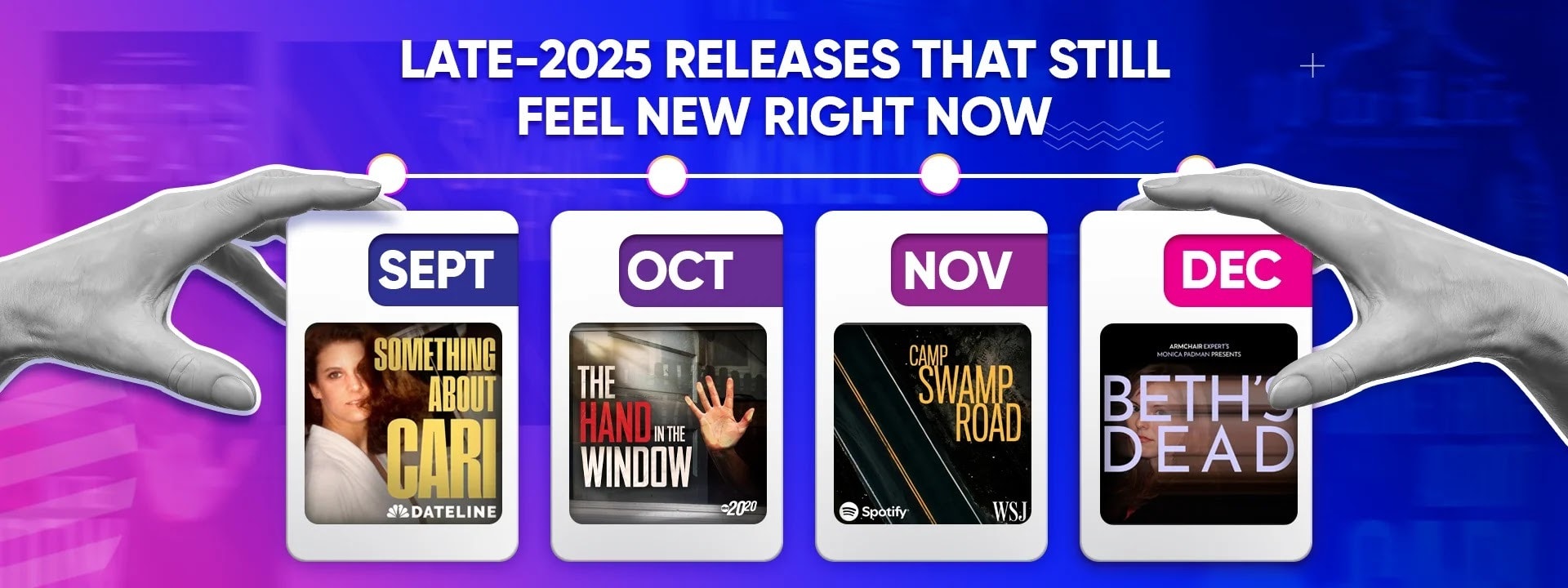
Late-2025 Releases That Still Feel New Right Now
A true crime story always has momentum because there is a question that the audience wants to be answered, and there is a timeline that is followed. And some of them run until now, and that makes them still relevant.
If you’re thinking “new to me,” this section is gold.
A lot of new true crime podcasts take months to spread. ‘New shows’ from Apple and Spotify that if you don’t look at the new releases you will definitely miss.
People recommend them slowly. Then suddenly everyone is talking about them like they just dropped yesterday.
Dateline Presents: Something About Cari
This one is polished and bingeable, the way Dateline productions usually are.
It’s the kind of true crime story where the details keep stacking until you realize you’re fully invested. You start the first episode curious. You end up listening at 1.5x speed because you need to know what happened.
Episode 4: “A Shot in the Dark” is the one that makes folks say, “Wait…WHAT?” The whole story is based on one moment that feels like a scene from a thriller: Liz calls 911 and says she’s been shot in a park. The police investigation then takes a turn, and the episode synopsis promises a “stunning conclusion” concerning who truly pulled the trigger. At that time, most people who are listening recognize that this tale is not going where they thought it would.
Best for: people who want a clean narrative voice and a steady pace.
My take: this is one of those shows that makes you feel like you’re watching a documentary with your ears, but without the fluff.
Dead Certain: The Martha Moxley Murder
This one is a full-season series on the Martha Moxley murder, and it’s a good pick if you like classic cases told with a fresh lens.
The reason this still feels new is that the case itself has a long arc, and the story keeps pulling you forward through decades of questions, courtrooms, and unanswered debates.
CT Insider and People both wrote about the start of the series and stressed that it has new interviews, including Skakel’s first public statements since his conviction was reversed.
Best for: people who like a structured series and a case history that actually matters.
My take: I prefer this type of show when it includes interviews and real reporting, not just a retelling. This one leans into that, including coverage tied to Michael Skakel.
And yes, it has that “wait, new evidence?” feeling at points, which is exactly what keeps people listening.
The Hand in the Window
This is a tightly produced limited series that feels like a TV investigation translated into audio.
It’s got that clean “here’s what we know, here’s what we’re chasing” structure that makes listening easy, especially if you’re multitasking.
The scenario that grabs people’s attention right away is the one that the whole series is based on: a lady who has been kidnapped calls 911 using her captor’s phone, putting her life in danger. That’s not a slow start. That’s the story that pulls you in right away.
Best for: listeners who want a contained series that doesn’t wander.
My take: I like these when they keep the timeline clear. This one does.
Camp Swamp Road
This is reported in a way that stays grounded. That’s the best compliment I can give a lot of true crime.
It follows a case that could have stayed local, but didn’t. And that shift is the story.
I wish to point out the beginning of Episode 1: “Mess Around, Find Out.” It starts with a 911 call about a careless driver with a pistol, and then things get so bad so quickly that it’s hard to believe it’s true.
Best for: people who like investigative podcasts with real reporting and a clear narrative drive.
My take: it’s a great example of how a police investigation and public narrative can move in different directions, and how reporting can help connect the dots.
BETH’S DEAD
This one has a different energy.
If you want the moment you will remember, it’s the one that keeps coming up in discussion threads: the Zoom call with the son. People on the Armchair Expert subreddit talk about that call as the point where they expected the team to react one way, and then got blindsided by how it actually landed.
It’s built around a personal obsession that turns into an actual investigation, and those are the podcasts that tend to pull people in fast. It feels like you’re being walked through a mystery by someone who genuinely can’t let it go.
Best for: listeners who like “how did this story even get discovered?” pacing.
My take: easy to get hooked. Dangerous for bedtime listening because you’ll say “one more episode” and then it’s suddenly 1:30 a.m.
10 to Life
This is more host-led and creator-driven.
It’s not the same vibe as a newsroom-produced investigative series. It’s faster, more format-based, and it will land best if you already like true crime commentary on YouTube.
You might start with the episode called “The Au Pair Murders: The Bodycam, 911 Calls, & Bizarre Footage,” which highlights exactly what this show does effectively.
Best for: listeners who want recurring structure and case coverage.
My take: if you’re newer to the genre or you like a consistent host voice, this can be a comfortable entry point.
Why True Crime Podcasts are Worth Your Time
Before we explore “how to choose the right podcast for you,” it is useful to explain why true crime works so well in audio format. Because it’s not just the topic. It’s also the structure.
A podcast that excels in true crime is story + structure + momentum. There is a salient question. There are events that lead to that question. There is the investigative part. And in a podcast done well, there is a reality check about people, systems, and consequences, not just a shocking headline.
And that’s why the “new” part counts.
Many older lists keep repeating the same classics. In the meantime, more recent seasons are getting tighter and better balanced. Many of the new true crime podcasts are also designed to be limited runs, so you are not committing to 300 episodes. You get a beginning, a middle, and a clean end.
Most people expect at least some of the following:
-
A clearly defined endpoint. These podcasts have a single case, a single storyline, and a single endpoint.
-
Reporting you can trust: Interviews, documents, real investigation, not just vibes.
-
Momentum: Episodes that move the story forward.
-
A reason to exist: A fresh angle, new evidence, a new perspective, or a case that hasn’t been overexposed.
That’s why the list leans toward limited series, newsroom-style reporting, and shows with a strong “why now.”
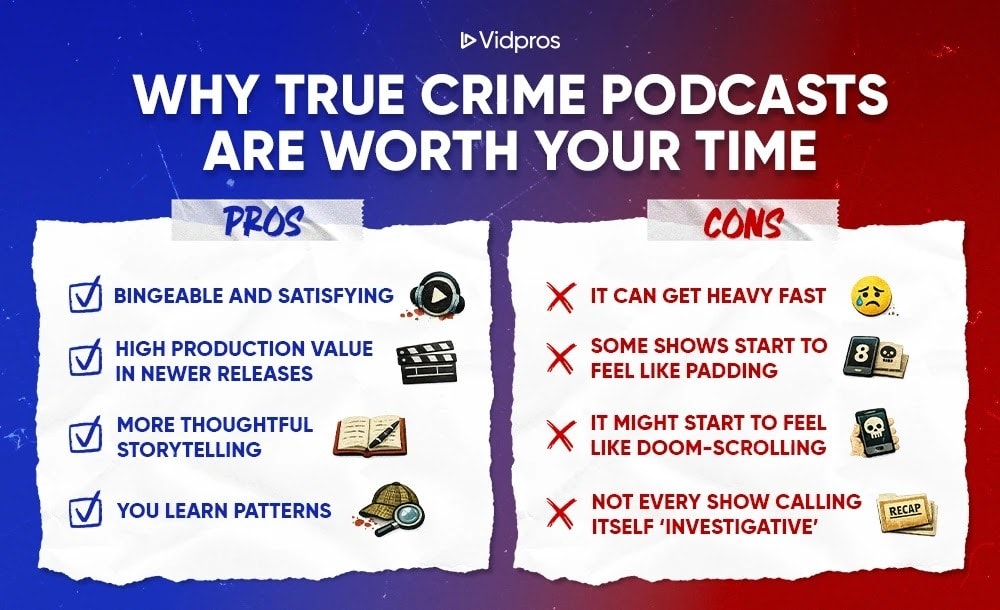
Pros
-
Bingeable and satisfying: Especially a new true crime podcast series that’s built to land somewhere.
-
High production value in newer releases: A lot of the 2025–2026 shows are polished without being overproduced.
-
More thoughtful storytelling: Many modern series are doing a better job of centering victims and avoiding cheap sensationalism.
-
You learn patterns: Not in a paranoid way. More like understanding how investigations unfold, how cases get mishandled, and how people can be misled.
Cons
-
It can get heavy fast: Even the respectful shows can hit you emotionally. Sometimes you’ll want a “not today” option.
-
Some shows start to feel like padding: You might get to episode four and think it could have just been four instead of eight. You’ll feel that when it happens.
-
It might start to feel like doom-scrolling: You might feel the world differently for a second when you bang out a couple of episodes in a row.
-
Not every show calling itself ‘investigative’ is actually so: for some shows, it is more of a recap than anything else. You’ll figure this out.
How to Pick Your Next Listen Without Wasting an Hour
There are too many new true crime podcasts 2026 has to offer. You don’t need more options. You need the right option tonight.
Here are the five questions I actually use:
-
Do you want an ending?
If yes, pick a new true crime podcast series with a fixed arc. If no, go weekly. -
Do you want reporting or reaction?
Reporting tends to feel calmer and more grounded. Reaction-led shows can feel more conversational. -
Do you want a case that’s still unfolding?
Ongoing cases sometimes come with new evidence, new filings, or updates that change how you see the story. -
Can you handle heavy material today?
Some episodes are built around trauma and loss. It’s okay to pick something lighter, even within true crime. -
Do you prefer a narrator or a “true crime author” style voice?
Some hosts sound like friends. Others sound like an audiobook. Both can work; it just depends on your mood.
Where to Find New True Crime Podcasts Before They Blow Up
You don’t need a complicated process. You need two or three reliable sources.
Here’s what I’d actually do:
Start with your podcast app’s category pages:
-
Apple and Spotify both surface “new” and “trending” rows in the true crime genre.
Then add one more layer:
-
Publisher pages from major podcast networks, because new series almost always get announced there first.
-
Listener communities, especially Reddit, because the “I’m absolutely hooked” posts tend to surface the good stuff fast.
And if you’re outside the US or you like UK audio in particular, this matters:
-
BBC Sounds can be a great place to discover investigative storytelling in a different style, even when the shows are not labeled the same way as US feeds.
Want to Turn These Podcast Hooks into Content People Actually Watch?
What makes true crime work is the stickiness of the structure. It begins with a question you simply can’t skip and feeds you just enough new bits of information to keep you leaning forward. It ends every beat in a way that makes the next one feel destined.
That’s not just a true crime thing. That’s a content thing.
So, creator, agency owner, or marketing manager, ethically copy the mechanics. Clip the cold open. Pull the turning-point moment. Create a short that ends with the question.
Vidpros is the answer if you don’t want to do any editing yourself. Try it out for $100 for one week of professional video editing and receive 10 short-form videos or 1 long-form video. It’s a simple way to see whether consistent output is the missing element without hiring people.
Frequently Asked Questions
Are true crime podcasts based on real cases, or are some dramatized?
Most true crime podcasts are based on real cases, but the style varies. Some stick to reporting and documents. Others are more narrative and interpretive. If you want the most “grounded” listens, look for shows that use interviews, court records, and on-the-record reporting.
Are these podcasts safe to listen to if I’m sensitive to graphic details?
Some are. Some aren’t. A lot of well-made shows keep the tone respectful, but the subject matter can still hit hard. If you’re sensitive, start with more documentary-style series and avoid anything centered on violence against children or sexual violence.
Where can I listen to these new true crime podcasts?
You can find most of them on Apple Podcasts and Spotify, and some are also hosted directly on network platforms like iHeart, NBC, or ESPN.
Which new true crime podcasts are best if I want serious investigative reporting?
Start with the reporting-heavy picks like Two-Faced: John of God, Valley of Shadows, Camp Swamp Road, and Dead Certain. Those lean into investigation, interviews, and structure instead of casual commentary.