

Do these AI video statistics show that this is just the next wave? What do users think? Companies? Creators? What do any of them think and how does this impact where the industry is and where it’s headed?
One thing is for sure, though, AI isn’t a separate tool as it’s now inside the software professionals already rely on for video editing and video creation.
In most of the existing AI video platforms, AI video generators and neural features are quietly becoming default tools.
So, for example, leading vendors including Adobe (Firefly), Apple (Neural Engine in Final Cut Pro), and Blackmagic Design (DaVinci Resolve neural tools), have added AI capabilities into their platforms. In a way this has changed what “video editing” actually means as millions of editors are already using AI video tools without labeling them as “AI users”.
The average marketing team can now produce video content in minutes using AI that relies heavily on natural language processing and natural language prompts.
AI has taken over the repetitive layers of editing, while humans are left with higher-level decisions (aka pacing or intent).
What’s more, by 2034, AI-powered editing is expected to stop being a differentiator and become an expectation.
Anyway, let’s look at the data and analyze what everything means.

General AI video statistics
- AI-based automation rose by 36% points, cloud collaboration increased by 55%, mobile editing grew by 27%, and 4K rendering was used by 47% of creators globally (Market Reports, 2026). That 36-point rise in automation inside the AI video market alone doesn’t just mean faster editing. It means decision-making is being outsourced. For example, cutting, timing, transitions, and even rough storytelling structures are increasingly handled by AI video tools instead of creators. And all the other data cited here show us one important thing, that automation is standardizing how creators think.
- AI video templates adoption rose by 22% (Market Reports, 2026). This is one of those AI video statistics that we feel are controversial. The rise of AI video generators and template-based video tools means more video creation starts from prebuilt logic (so, not original structure). Unfortunately, even creative AI video generators rely heavily on pattern repetition. So, that’s something to keep in mind if you’re a creator.
- One of the strongest trends is AI-assisted editing used by 58% of creators. (Market Reports, 2026). This is a tipping point statistic, as when more than half of users adopt a behavior, it’s not a trend anymore, as much as it is (or becomes) default behavior. People try AI video generators, create a few AI-generated videos, and move on. That’s why AI video platform users don’t grow at the same pace as tool launches even when AI video technology is making any structural decisions.
- Multilingual media production grew by 22%, driven by AI voiceovers and global editing features. (Market Reports, 2026). AI voiceovers and translation tools mean a single video can instantly become global content. Meaning that localization has finally become an automatic output option. Even though you must be careful as most AI-generated videos still lose emotive tone in translation.
- In commercial use, the demand for AI-assisted editing tools rose by 36% points (Market Reports, 2026). This shows that companies are replacing traditional video tools with AI-powered video tools, not for innovation, but for cost control in production costs and speed. Just be careful not to increase content volume while decreasing differentiation.
- The personal segment saw a 23% rise in AI template usage and a 29% increase in 4K editing among advanced hobbyists (Market Reports, 2026). Here, we kind of notice that professional together with amateur lines blur. Especially the jump in 4K editing shows that even non-professionals expect high-end video content quality. This can create pressure on video platforms because the average content quality is rising artificially.
- Venture capital activity increased by 19%, especially in AI editing engines and mobile-first platforms. (Market Reports, 2026). We’re not experts in this area, but with a simple logical assumption, it means that investors now assume editing will be AI-native by default.
- SMEs are adopting video at an 7.88% annual rate, using AI-guided tools for professional-quality content without large in-house teams (Mordor Intelligence, 2026). Apparently, SMEs are being pushed into video because attention has moved there, not because they want to become media companies. And while these AI tools do remove the need for teams, they also blur the line between what marketing is and what production means. This is also where production costs collapse, because AI video solutions replace traditional production pipelines.
- 58% of AI videos for marketing use AI voice-overs during editing, even replacing recorded voices for clearer and faster audio delivery (Zebracat, 2025). Voice used to be one of the most human aspects of video, so when possible, use human voice-overs even though we know it’s not always easy or cheap.
- In 2026, Google’s veo-3.1-audio model was ranked as the best text-to-video AI creator (Statista, 2026). Not a surprise, really, as this only shows that text-to-video generation is becoming a competitive frontier. Instead of editing footage, creators prefer AI-generated videos from prompts.
The impact of AI video generation
- AI accelerates tasks such as clipping, color matching and audio enhancement, saving professionals around 200 hours per year and enabling newcomers to create polished output (Mordor Intelligence, 2026). While saving time is great and all, unlike what most people or creators think saved time is not always “freed creativity.” In many cases, it becomes pressure to just produce more and more.
- The fast integration of AI into professional software means that 21% of editors require reskilling to acclimate to new tools (Market Reports, 2026). Some editors are no longer only working in video editing timelines. They are learning to manage AI video generation, AI prompts, AI automation layers, and hybrid workflows across video platforms.
- Users of AI-augmented editing platforms reported a 47% drop in average project completion time when compared to traditional systems. (Data Intelo).
- Platforms like Sora, Veo, and Runway Gen-3 are creating a new category of editing demand for hybrid human-AI workflows where editors refine and post-process AI-generated segments. (Data Intelo). This kind of creates a new role: the “video orchestrator.”
- Growing competition from free and freemium platforms is eroding the price floor in the consumer and prosumer segments, making it harder to justify premium pricing without AI differentiation (Data Intelo). When free tools are “good enough,” paid tools are not anymore competing on baseline functionality and must focus on either extreme specialization or AI advantage. (This is also why AI video startups are focusing less on editing and more on AI video workflow).
- AI-related content incidents rose from about 50 in early 2020, to over 200 in early 2024, and nearly 500 by January 2026, including deepfakes and synthetic media flooding platforms. (OECD, 2026). Unfortunately, the same tools enabling creativity are also enabling manipulation at scale.
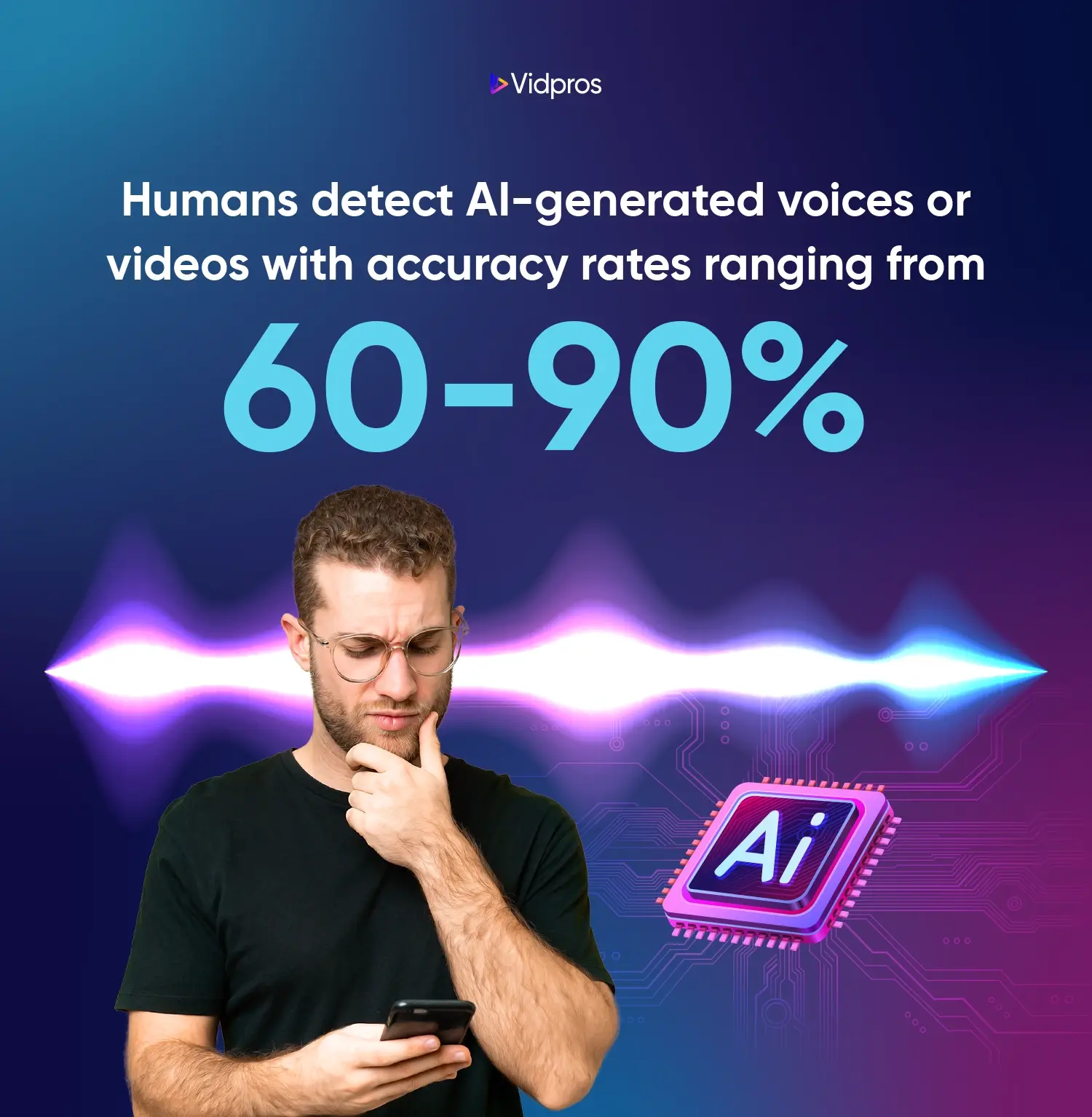
- Research shows humans detect AI-generated voices or videos with accuracy rates ranging from 60% to 90%. (PMC, 2026). Which means detection is inconsistent and not reliable and perception becomes unstable now as deepfakes, misinformation, and synthetic media are becoming part of the video consumption environment. There is still a huge regulatory and legal uncertainty in this dimension.
- 1 in 17 teens have already been targeted by deepfake content (Education Week Report, 2025). Another impact of AI video beyond industry use cases. Even YouTube users are unknowingly consuming AI-generated content in recommendation loops.

Source: Statista
Regional AI video statistics
- Social video output in the Asia- Pacific region grew by 46%, driving demand for AI editing solutions and automation (Market Reports, 2026). Users expect instant editing, instant effects, instant publishing, instant everything.
- In the US, Gen X showed the highest openness to AI content at 35% and Gen Z demonstrated the lowest at 25% (Statista, 2025). One possible explanation for this may be exposure as Gen Z has grown up inside platforms flooded with algorithmic video content, so they probably are more sensitive to “real content.”
- But while 7% of the youngest respondents surveyed refused to watch AI-made content, 17% of Gen X did (Statista, 2025). Why is that? Maybe because while younger users consume AI content without rejecting it explicitly, they still distinguish between “real” and “AI” and subconsciously prefer one or the other.
- Globally, 36% of respondents said they use AI to improve or generate video effects to layer on videos (Statista, 2025). So, some users are not handing over full control to AI but are using it as a layer within traditional workflows.
- In surveys from the US and UK, over 69% of respondents were interested or very interested in AI-powered trailer reels, reflecting individual preferences. (Statista, 2026). This is one of those clearest signals of where media consumption is heading which is a hyper personalized content creation, especially in entertainment. Interactive video content and personalized video content are still very underused.
Capping off
Across all these statistics, one pattern shows up repeatedly, even if it is never stated directly: video production is becoming faster, more automated, but also more fragmented, more dependent on AI driven video tools, and not necessarily easier to manage.
The global AI video market is rewarding speed, but audiences still respond to good quality. And that mismatch is why so many video marketing efforts today feel “almost good”.
Because generating a video is no longer the hard part as much as it is creating a great video that actually converts. Even with advanced AI video tools, you can still struggle to create good content.
How can you achieve that though? Vidpros takes what the AI video market is making easier (raw creation) and solves what it is still not solving (original, polished, professional, ready-to-publish output).
You can test it with a $100 trial and get either:
- 10 short-form videos, or
- 1 long-form video
professionally edited and ready to use.
We are solving the production reality that all those video editing tools are creating. Curious about pricing? Check it out here! Not sure? Watch the demo!