
Want to see Nano Banana in action? Check out our full video breakdown on the Vidpros YouTube channel, where we put this tool through its paces and show you precisely what it can (and can’t) do.
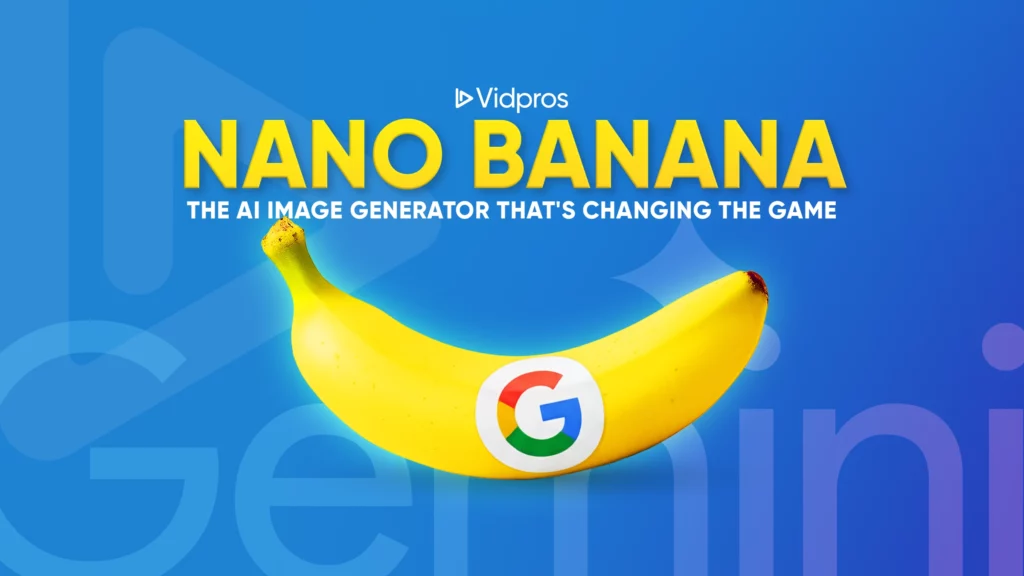
Imagine creating professional-looking thumbnails in under five seconds. No Photoshop skills required. No expensive software. Just type what you want, and watch it happen. That’s precisely what Google’s newest image editing model, nicknamed ‘Nano Banana,’ promises to deliver.
But is this really the game-changer everyone’s talking about, or just another overhyped tech tool? We put it to the test to find out.
What is Nano Banana in Gemini?

Nano Banana isn’t just a quirky codename; it’s Google’s way of making their new image editing model, Gemini 2.5 Flash Image, more approachable. This AI tool lives inside the Gemini app and Google AI Studio, and the best part? It’s completely free to use.
Think of it as having a super-smart design assistant who understands plain English. Want to put yourself in a banana costume? Just ask. Need to add confetti rain to a photo? Type it out. Want to change the entire background of an image? Done in seconds.
The model can blur backgrounds, remove stains from clothing, remove entire people from photos, alter poses, add color to black and white images, and much more– all with simple text commands.
What makes Nano Banana different?

While other AI image tools exist, Nano Banana has some unique tricks up its sleeve:
- Speed that actually matters. Gemini 2.5 Flash generates images within 3 to 4 seconds, while ChatGPT takes more than a minute to produce a single image. When you’re working with multiple images and edits, this speed difference is enormous.
- Face and identity protection: Unlike many AI tools that completely change how people look, Nano Banana keeps your facial features and identity consistent. You can change costumes, locations, and settings while maintaining the same character identity. You can upload multiple photos and apply consistent edits across your entire batch.
- Conversational editing: The model’s core strength is its deep language understanding. A narrative, descriptive paragraph will almost always produce a better, more coherent image than a list of keywords. Instead of learning complex menus and complex editing instructions, you describe what you want.
The real test: Professional vs Amateur results

To see how Nano Banana really performs, we conducted a fascinating experiment comparing three different approaches to creating the same thumbnail project:
Approach 1: Traditional Professional
Using standard Photoshop tools, a professional designer created a polished thumbnail. The result was attention-grabbing, well thought out, and perfectly tailored for social media—clearly designed by someone with years of experience who understands what works. However, this approach took significantly more time and required extensive design expertise.
Approach 2: Amateur with Nano Banana
An amateur with zero design skills used only Nano Banana to create multiple thumbnail variations. The results were surprisingly clean, simple, and beautiful—demonstrating consistent quality across different concepts. Most importantly, this was both time and cost-effective, producing professional-looking thumbnails that would have been impossible for this person to create with traditional tools alone.
Approach 3: Professional with Nano Banana
When a professional designer combined their expertise with Nano Banana’s capabilities, the results reached the next level—a Hollywood-level production quality. The AI tool dramatically boosted speed, but the human touch elevated the final output to something AI alone couldn’t achieve, maintaining the professional vision and creativity that only human expertise can provide.
The takeaway
AI tools won’t replace designers—they’ll empower them. For beginners, Nano Banana serves as a gateway to creating quality content. For professionals, it serves as an accelerator, enabling them to focus on their creative vision while AI handles the technical execution.
Image editing limitations

Despite the impressive results, Nano Banana isn’t perfect. Here are the most common frustrations users encounter:
- Missing basic features. The tool also struggles with precise local edits that require pixel-perfect accuracy. Believe it or not, Nano Banana can’t even crop an image to a specific size. Many fundamental editing tools that designers take for granted don’t exist.
- Technical glitches. Sometimes you type a request, hit generate, and nothing happens. The tool returns your original photo. Some users report this happening almost half the time, which can be incredibly frustrating when you’re on a deadline.
- Quality degradation. This image generation tool works excellently for one or two edits, but push it too far with multiple changes, and the edited image quality can get weird and unpredictable.
- Resolution issues. The aspect ratio, dimensions, and resolution are predominantly random. Even when you specify the size in your prompt, the AI often responds that it can’t create images in that specific size.
- Prompt dependency. If you’re not good at describing what you want in clear, detailed language, your results will vary wildly.
The watermark situation and ethics
All images created with Gemini 2.5 Flash Image include both visible watermarks (when using the Gemini interface) and invisible SynthID digital watermarks to identify them as AI-generated.
While this transparency is essential, it creates some challenges:
- The visible watermarks can often be cropped out.
- Not every platform recognizes the invisible SynthID watermarks yet.
- People can still alter images to remove evidence of AI generation.
The deepfake concern
Because Nano Banana excels at keeping faces and identities consistent, there’s potential for abuse. Imagine seeing a fake ad featuring a celebrity endorsing a questionable product, and not being able to tell it’s fake. This technology makes such scenarios increasingly possible.
How Google Gemini stacks up against the competition

When compared to other AI image generators like ChatGPT’s DALL-E, Gemini tends to produce more realistic and detailed results, especially for photorealistic images. However, each tool has its strengths:
- Speed. Nano Banana wins by a considerable margin.
- Quality. Results vary, but Gemini often produces more realistic images.
- Features. Traditional tools still offer more comprehensive editing options.
- Cost. Nano Banana’s free tier gives it a significant advantage.
What Gemini 2.5 Flash Image means for Graphic Designers

Here’s the million-dollar question: Is this the end of graphic designers?
The short answer is no, but it’s definitely changing the game. Think of AI as getting you 80-90% of the way there in seconds. But to reach that final 10% of polish– perfecting colors, refining proportions, adding professional graphics, human creativity and expertise remain essential.
The real power lies in collaboration. Designers who embrace these tools can:
- Dramatically reduce time spent on basic tasks.
- Focus more energy on creative vision and strategy.
- Generate consistent brand assets and offer more competitive pricing to clients.
- Experiment with ideas faster than ever before.
For beginners, Nano Banana lowers the barrier to entry. You don’t need years of Photoshop training to create decent-looking graphics. However, you still need ideas, style, and vision– and not everyone has that creative spark.
Practical tips for getting started
If you want to try Nano Banana, here are some best practices:
- Write like you’re telling a story. Describe the scene rather than just listing keywords. Instead of “dog, park, sunny,” try “A golden retriever playing in a sunny park with green grass and trees in the background.”
- Start simple. Try one or two edits first before attempting complex transformations.
- Be patient with glitches. If something doesn’t work, try rephrasing your prompt or starting over.
- Know when to switch tools. Use Nano Banana for quick concepts and basic edits, but switch to traditional tools for precision work and final polish.
Image Editing and Human-AI Collaboration
Nano Banana represents something bigger than just another AI tool– it’s a glimpse into the future of creative work. We’re moving toward a world where AI handles the technical grunt work, freeing humans to focus on the creative vision and strategic thinking that machines can’t replicate.
This doesn’t mean creative jobs are disappearing. Instead, they’re evolving. The most successful creators of the future will be those who learn to work alongside AI tools, using them to amplify their creativity rather than replace it.
Capping off
So, is Google’s Nano Banana the future of image editing or just a bizarre fruit name? Honestly, it’s both.
It’s fast, powerful, and makes editing feel like magic. For quick social media content, thumbnail creation, and basic image manipulation, it’s genuinely impressive. The speed alone makes it worth trying for content creators who need to produce visuals quickly.
But remember, it’s still just a tool. AI can take you far, but that final bit of polish, that human touch, that understanding of what actually connects with audiences? That’s still where the real magic happens.
Whether you’re a complete beginner looking to create your first graphics or a seasoned professional wanting to speed up your workflow, Nano Banana is worth exploring. Just don’t expect it to replace your creative brain anytime soon.
The future isn’t about humans versus AI, it’s about humans working with AI to create things neither could accomplish alone. And that’s pretty exciting.